


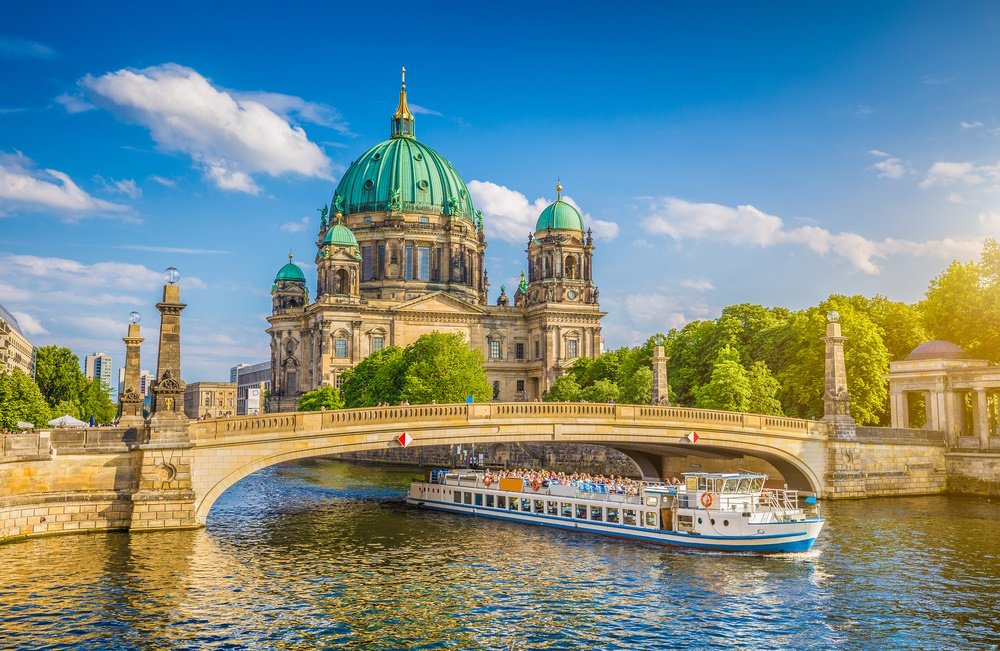
The largest city in Germany is Berlin. With over 3.8 million residents, the capital is nearly twice as large as the runner-up, Hamburg. Germany has a total of four cities that cross the one-million inhabitant mark: Berlin, Hamburg, Munich, and Cologne.
While in many countries all the action is centered in the capital, in Germany the roles are distributed. Frankfurt is the financial heart, Hamburg has the port, and Munich has the industry.
1. Berlin (3.8 million residents)
The undisputed number one. Since the fall of the Wall, Berlin has grown explosively into one of the hippest metropolises in Europe. It is a city of massive contrasts: from the historical grandeur around the Brandenburg Gate to raw techno clubs in old power plants. Politically, it is the most powerful city, but economically, cities in the south are often wealthier.
2. Hamburg (1.9 million residents)
The “Gateway to the World.” Hamburg is Germany’s most important port city and the second-largest city in the country. What many people do not know is that Hamburg has more bridges than Venice and Amsterdam combined (approximately 2,500). The city is known for its immense wealth, the media industry, and the notorious nightlife street, the Reeperbahn.
3. Munich (1.5 million residents)
Munich is the capital of the state of Bavaria and feels like a completely different country to many Germans. It is sometimes mockingly called the “Millionendorf” (village of a million) because the atmosphere is cozy and traditional despite its size. It is the home base for global brands like BMW and Siemens, and of course, the Oktoberfest.
4. Cologne (1.1 million residents)
The fourth and final “Million-city.” Cologne (Köln) is situated on the Rhine and is dominated by the gigantic Cathedral, which miraculously survived World War II while the rest of the city was bombed flat. The residents are known for their relaxed attitude toward life (“Kölsche Art”) and their celebration of Carnival.
5. Frankfurt am Main (775,000 residents)
Frankfurt is the city of money. Due to its impressive skyline of skyscrapers, it is also called “Mainhattan.” It is the home of the European Central Bank and has one of the largest airports in Europe. Despite its international allure, the city is surprisingly compact in terms of area and population.
6. Stuttgart (633,000 residents)
Stuttgart is the car capital of Europe. Both Mercedes-Benz and Porsche have their headquarters here. The city lies in a valley (the “Stuttgarter Kessel”), which provides beautiful views but also brings heat in the summer. The surrounding region is one of the wealthiest and most innovative areas in the European Union.
7. Düsseldorf (625,000 residents)
The eternal rival of Cologne (which is located 40 kilometers away). Where Cologne is down-to-earth, Düsseldorf is chic. The city is known for the “Königsallee” (the high-end shopping street of Germany) and the fashion industry. The old town is promoted by tourism boards as the “longest bar in the world” due to its string of pubs.
8. Leipzig (615,000 residents)
This is the fastest climber on the list. Leipzig (in former East Germany) is growing so rapidly that it recently overtook Dortmund. Due to low rents and a creative atmosphere, it is also called “Hypezig” or “the new Berlin.” Historically, it is the city of music legend Johann Sebastian Bach.
9. Dortmund (590,000 residents)
The largest city in the Ruhr area. Everything used to revolve around coal and steel here, but Dortmund has transformed itself into a city of technology and culture. And of course, football: Borussia Dortmund attracts more than 80,000 spectators to the stadium weekly, which has a massive influence on the city’s identity and economy.
10. Essen (585,000 residents)
Following closely behind Dortmund is Essen, the historical heart of German heavy industry. The Krupp family built an empire here. Today, the old coal mine Zeche Zollverein—once the largest in the world—is a stunning UNESCO World Heritage site and a symbol of the region’s change. Essen is now a green city and the energy capital of Germany (major energy companies are based here).
