


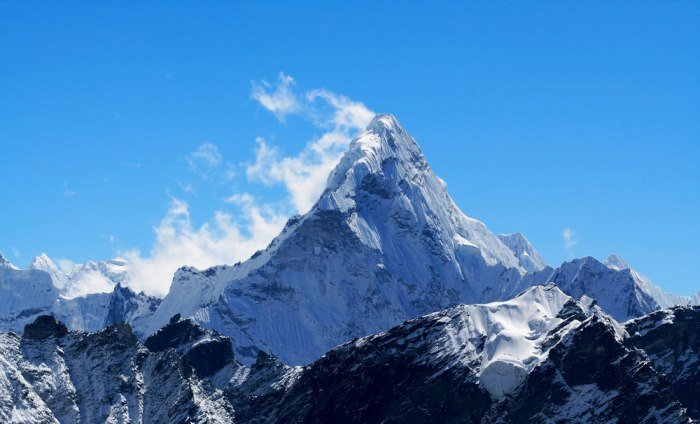
The highest point on Earth is the summit of Mount Everest. Standing at an official height of 8,848 meters (29,031 feet) above sea level, it sits on the border between Nepal and China. It is the crown jewel of the Himalayas, over 200 meters taller than its nearest rival, K2. To reach the top, climbers must endure the Death Zone, where the oxygen levels are so low that the human body literally begins to die with every passing minute.
For centuries, the great mountain ranges of Asia remained a mystery to the West. However, for the locals, these peaks were the homes of gods and spirits. There are only fourteen mountains in the world that rise above the magic limit of 8,000 meters. All of them are located in the Himalayas and the Karakoram ranges. Climbing these giants is the ultimate test of human endurance, mental fortitude, and physiological limits. In the thin air of high altitude, simple tasks become Herculean efforts, and the line between life and death is often as thin as a gust of wind. These are the ten tallest pillars of our planet.
1. Mount Everest (8,848 m)
Everest, known as Sagarmatha in Nepal and Chomolungma in Tibet, is more than just a mountain; it is a global icon. Since the first successful ascent by Hillary and Norgay, thousands have flocked to its slopes. While modern technology and commercial expeditions have made it more accessible, it remains a graveyard for many. The infamous “Hillary Step” and the Khumbu Icefall are just two of the deadly obstacles climbers must navigate. According to records from National Geographic, the mountain continues to grow by about 4 millimeters every year due to tectonic plate shifts, keeping the race for the summit eternally relevant.
2. K2 (8,611 m)
Ask any professional mountaineer which peak they fear most, and the answer is almost always K2. Located on the border of Pakistan and China, K2 is known as the “Savage Mountain.” It is steeper, more technical, and much more dangerous than Everest. While Everest is often crowded, K2 is the domain of the elite. Statistics show that for every four people who reach the summit, one person dies attempting it. It was the last of the fourteen peaks to be conquered in winter, a feat only achieved recently by a determined Sherpa team. Its weather is notoriously unpredictable, often trapping climbers in lethal storms for days.
3. Kangchenjunga (8,586 m)
Until 1852, Kangchenjunga was thought to be the highest mountain in the world. It is a massive, sprawling peak with five distinct summits, giving it the name “The Five Treasures of the Snow.” It is located on the border between Nepal and the Indian state of Sikkim. Out of deep respect for local religious beliefs, many climbers follow a long-standing tradition of stopping a few meters short of the actual summit to keep the “seat of the gods” untouched. Britannica notes that its remote location makes the trek to base camp an adventure in itself, far from the bustling crowds of the Everest region.
4. Lhotse (8,516 m)
Lhotse is often overshadowed by its famous neighbor, Everest. The two peaks are connected by the South Col, a high-altitude ridge. For a long time, Lhotse was ignored as climbers aimed for the ultimate prize next door. However, the Lhotse Face is one of the most daunting sights in mountaineering—a literal wall of blue ice that rises over 1,000 meters. Climbing Lhotse is now a prestigious goal in its own right, and some extreme athletes even attempt to summit both Everest and Lhotse in a single 24-hour push, a feat that requires superhuman stamina.
5. Makalu (8,485 m)
Makalu is instantly recognizable by its perfect, four-sided pyramid shape. It stands in isolation, about 19 kilometers southeast of Everest. This isolation means the mountain is exposed to the full force of the wind, making the climb exceptionally cold and difficult. It is considered one of the most technical 8,000-meter peaks, requiring high-level rock and ice climbing skills rather than just endurance. The final scramble to the summit is a notorious knife-edge ridge that has turned back many seasoned professionals.
6. Cho Oyu (8,188 m)
In the world of eight-thousanders, Cho Oyu is often described as the “easiest” (though nothing is easy at 8 kilometers up). Its slopes are relatively gentle compared to its neighbors. Because of this, it is the most popular choice for climbers looking to bag their first 8,000-meter peak. Many expeditions use Cho Oyu as a training ground for Everest. NASA Earth Observatory images show how the mountain sits on the main trade route between Tibet and Nepal, a historical path used by yak caravans for centuries.
7. Dhaulagiri I (8,167 m)
The name Dhaulagiri means “Dazzling White Mountain,” and it lives up to the name. It is a stunning massif in Nepal that was once thought to be the highest in the world. It is famous for its massive southern face, which rises 7,000 meters from the valley floor—one of the greatest vertical rises on the planet. Dhaulagiri is notorious for its fierce storms and high risk of avalanches. It remained unclimbed for a long time simply because its routes were so difficult to find and sustain.
8. Manaslu (8,163 m)
Manaslu is known as the “Mountain of the Spirit.” It is located in the Gorkha region of Nepal. In recent years, it has seen a surge in popularity as a more affordable alternative to Everest. However, Manaslu has a dark side. The mountain is extremely prone to avalanches due to its steep, snow-loaded slopes. Despite the risks, the surrounding Manaslu Circuit trek is considered one of the most beautiful in Nepal, offering a glimpse into ancient Tibetan-influenced cultures that remain untouched by the modern world.
9. Nanga Parbat (8,126 m)
Located in Pakistan, Nanga Parbat is nicknamed the “Killer Mountain.” Before its first successful ascent, 31 people died trying to reach the top. It is home to the Rupal Face, which is the highest mountain wall in the world—a sheer drop of 4.6 kilometers. Unlike the other peaks which are part of a continuous range, Nanga Parbat rises alone from the Indus Valley, making it a target for extreme weather. It is a brutal, unforgiving mountain that demands absolute respect from those who dare to step on its slopes.
10. Annapurna I (8,091 m)
We close the list with the most dangerous mountain of all. While it is the tenth tallest, Annapurna I has the highest fatality-to-summit ratio of any peak on Earth. For every three people who reach the top, one dies. It was the first 8,000-meter peak ever climbed (in 1950), but its treacherous ice walls and frequent snow slides make it a nightmare for modern climbers. The mountain is a complex massif with many secondary peaks, all of which are subject to some of the most volatile weather in the Himalayas.
