The German-language music scene has produced some of the most distinctive, poetic, and boundary-pushing vocalists in European cultural history. Far beyond stereotypical beer-tent folk or simplistic pop, German popular music encompasses groundbreaking new wave, industrial rock, literary acoustic ballads, and socially conscious rock anthems that filled football stadiums across decades.
From legendary rock icons who challenged Cold War political divisions to chart-topping schlager and pop-rock masters, German vocalists have demonstrated remarkable lyrical depth. Here are ten of the greatest and most influential German-language singers of all time.
10. Heino
Instantly recognizable by his platinum-blond hair and signature dark sunglasses, Heino (Heinz Georg Kramm) has been a fixture of German traditional Volksmusik and schlager for more than half a century. With his deep, resonant bass-baritone voice, Heino sold over fifty million records to generations of loyal listeners.
In 2013, the veteran singer shocked the nation by releasing Mit freundlichen Grüßen, a surprising album of hard-rock covers of songs by Rammstein and Die Ärzte that topped German album charts, proving his enduring cultural appeal.
9. Freddy Quinn
Austrian-born Freddy Quinn became the defining voice of West Germany’s post-war economic miracle (Wirtschaftswunder) during the late 1950s and 1960s. Singing melancholy sailor ballads about wandering distant oceans and yearning for home on classics like “Junge, komm bald wieder,” Quinn achieved ten number-one singles.
His warm, melancholy baritone spoke directly to a generation rebuilding their lives in divided Germany, making him one of the most commercially successful recording artists in European history.
8. Xavier Naidoo
Possessing one of the smoothest, most expressive soul tenors in European music, Mannheim-born Xavier Naidoo pioneered modern German-language R&B both as a solo artist and as frontman of the musical collective Söhne Mannheims. Soulful ballads like “Nicht von dieser Welt” and “Dieser Weg” demonstrated that the German language could sound deeply warm and emotional.
His acoustic performances and intricate vocal runs earned universal critical acclaim, inspiring a whole generation of contemporary German soul and urban vocalists.
7. Till Lindemann
As the commanding frontman of Neue Deutsche Härte pioneers Rammstein, former competitive swimmer Till Lindemann has carried German-language rock to sold-out stadiums across six continents. Known for his rolling “R” pronunciations, deep operatic bass voice, and pyrotechnic stage spectacles, Lindemann’s provocative lyricism explores taboo human psychology with literary intensity.
His guttural vocal presence and theatrical staging turned heavy industrial rock into a globally recognized German cultural export.
6. Peter Maffay
Romanian-born Peter Maffay holds an untouchable commercial record in German music history, with twenty-one number-one albums across five decades. After debuting in schlager with the chart-topping hit “Du,” Maffay transitioned into hard-hitting blue-collar rock.
He created the beloved musical fairy tale Tabaluga for children and established charitable foundations for disadvantaged youth, remaining one of Germany’s most respected public figures.
5. Reinhard Mey
The supreme master of the German Liedermacher (singer-songwriter) tradition, Reinhard Mey has spent sixty years crafting literate, satirical, and deeply touching acoustic folk songs. Armed with his classical nylon-string guitar and crisp Berlin diction, Mey turns mundane everyday moments into profound philosophical reflections.
His 1974 signature classic “Über den Wolken” (Above the Clouds) remains an unofficial national anthem celebrating human freedom and perspective, cherished by generations of fans.
4. Falco
While born in Vienna, Austria, Falco (Johann Hölzel) remains the most internationally successful German-language pop artist in history. His rapid-fire rap-spoken cadences on “Rock Me Amadeus” (1985) topped the Billboard Hot 100 in the United States, a feat no other German-language song has ever achieved.
His theatrical, aristocratic visual persona and sharp, bilingual wordplay redefined European new wave pop, establishing a legacy that continues to influence contemporary hip-hop and electronic artists.
3. Udo Jürgens
Another iconic Austrian who dominated the German-speaking entertainment world, Udo Jürgens composed over a thousand songs and won the 1966 Eurovision Song Contest with “Merci, Chérie.” Famous for concluding his high-energy arena concerts playing a white grand piano while wearing a white terrycloth bathrobe, Jürgens married catchy melodies with sharp social critique on hits like “Griechischer Wein.”
His songs examined guest-worker loneliness, environmental degradation, and human mortality while keeping stadium audiences singing along in unison.
2. Herbert Grönemeyer
After rising to international fame playing Lieutenant Werner in Wolfgang Petersen’s legendary submarine film Das Boot, Herbert Grönemeyer became Germany’s most celebrated rock singer. His 1984 opus 4630 Bochum remains one of the best-selling German records in history, celebrating industrial Ruhr valley working-class pride.
His grief-stricken 2002 masterpiece Mensch, written after the tragic loss of his wife and brother, captured the heart of the entire nation, standing as a monument of musical healing.
1. Udo Lindenberg
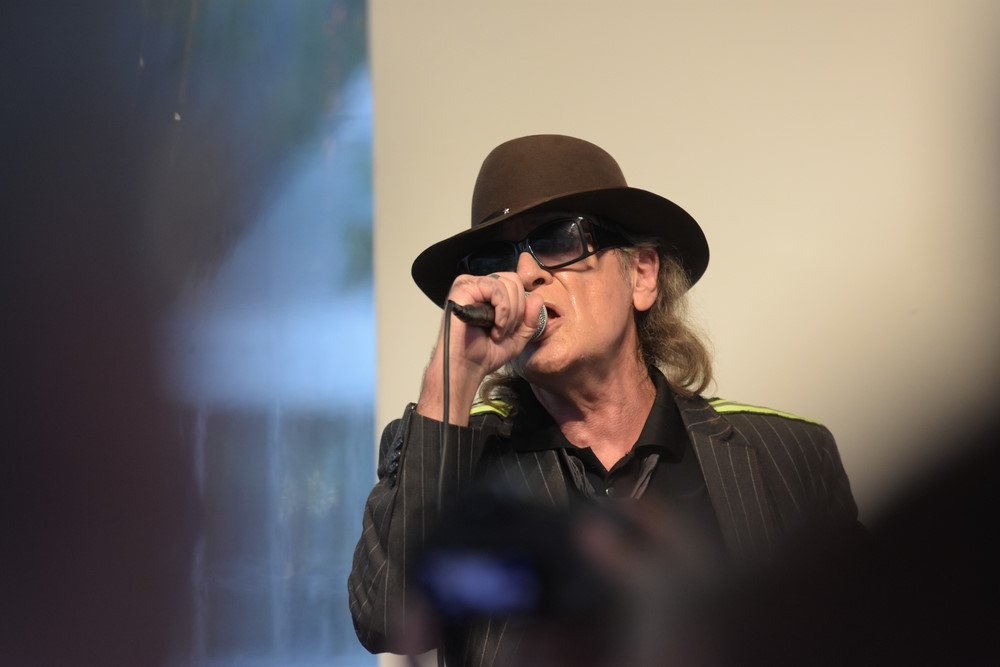
With his signature fedora, tinted sunglasses, and dry Hamburg street slang, Udo Lindenberg effectively invented modern German rock music with his Panikorchester in 1973. At a time when German acts sang exclusively in English, Lindenberg proved that colloquial German had its own natural rock rhythm.
His cheeky 1983 hit “Sonderzug nach Pankow” mocked East German leader Erich Honecker, eventually breaking through political iron curtains to perform in East Berlin, cementing him as the immortal founding father of German rock culture.