


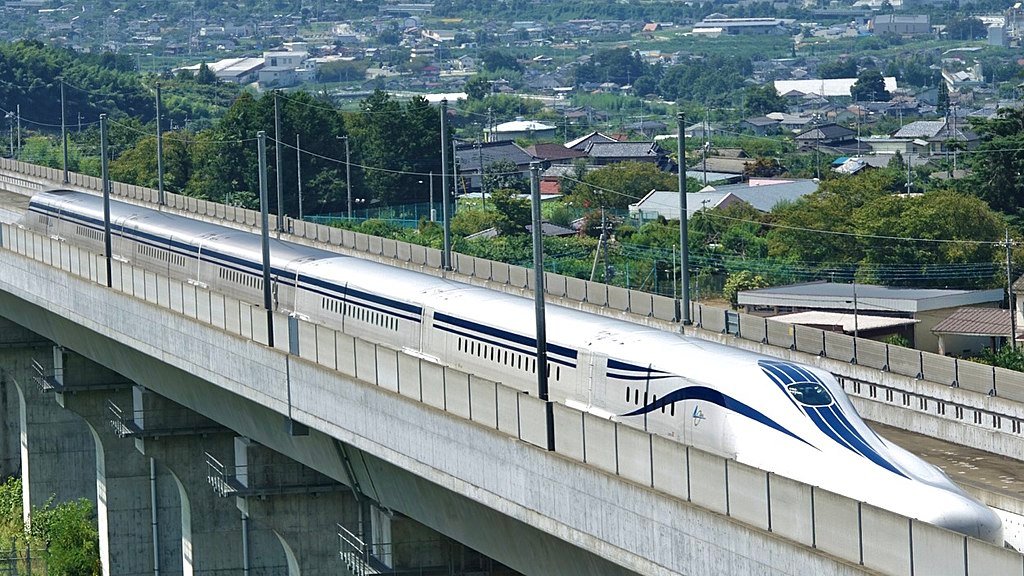
The world’s fastest train is the Japanese L0 Series Maglev. During a test run in 2015, this levitating train shattered all records by reaching a speed of 603 km/h (375 mph). The fastest train for which you can currently buy a ticket is the Shanghai Transrapid, which whisks you to the airport at 460 km/h (286 mph).
The battle for the fastest train is primarily fought between Asia (China and Japan) and Europe (France and Germany).
1. L0 Series Maglev (603 km/h) – Japan
This train has no wheels but floats above the track thanks to powerful magnets (Magnetic Levitation). This eliminates all friction. Japan Railways (JR Central) is developing this train for the new Chuo Shinkansen line between Tokyo and Nagoya. According to the official website, the train will cover a distance in 40 minutes that currently takes an hour and a half.
2. TGV POS / V150 (574.8 km/h) – France
The TGV is the pride of France. Although they ‘only’ travel at 320 km/h with passengers, a specially modified TGV (the V150) showed what is truly possible on wheels in 2007. On the track between Paris and Strasbourg, it reached nearly 575 km/h. This remains the world record for a conventional train on steel rails.
3. Shanghai Transrapid (460 km/h) – China
The fastest commercial train in the world. This Maglev connects the city of Shanghai with Pudong International Airport. The technology is originally German (Siemens). The 30-kilometer journey takes only 7 minutes and 20 seconds. At full speed, passengers hang in the curves as if they are in an airplane.
4. CR400 ‘Fuxing’ (350 – 420 km/h) – China
China has the largest high-speed network in the world. The ‘Fuxing’ (Rejuvenation) is their latest standard train. It operates at 350 km/h but has been successfully tested up to 420 km/h (during a test where two trains passed each other). According to state media, the goal is to eventually increase the standard speed to 400 km/h.
5. ICE 3 (330 km/h) – Germany
The InterCity Express is the German answer to the TGV. The ICE 3 is built for speeds up to 330 km/h, although in Germany they often run at a maximum of 300 or 320 km/h. What makes the ICE 3 unique is that the motors are distributed throughout the entire train (instead of just in the locomotive), allowing it to accelerate faster and climb hills more efficiently.
6. JR Shinkansen E5 (320 km/h) – Japan
The famous ‘Bullet Train’. You can immediately recognize the E5 series by its extremely long nose (15 meters long). That nose is necessary to prevent a pressure wave when the train enters a tunnel at 320 km/h; without it, a loud bang would occur at the other end of the tunnel (the ‘tunnel boom’ effect).
7. Al Boraq (320 km/h) – Morocco
The fastest train in Africa. Al Boraq runs between Casablanca and Tangier. The trains are French-made (double-decker TGVs) and the track was specially built for high speeds. The travel time between the two cities has been more than halved as a result.
8. AVE Class 103 (310 km/h) – Spain
Spain has the largest high-speed network in the world after China. The S-103 (a variant of the German ICE 3) connects Madrid with Barcelona. During testing, this train reached over 400 km/h, but with passengers, they keep it safe at 310 km/h. Passengers receive their money back if the train is more than 15 minutes late, showing their confidence in the service.
9. KTX-Sancheon (305 km/h) – South Korea
South Korea developed its own technology after initially using French trains. The KTX-Sancheon is named after an indigenous fish (the cherry salmon) because of its aerodynamic shape. It connects Seoul with the port city of Busan in less than two and a half hours.
10. Frecciarossa 1000 (300 km/h) – Italy
The “Red Arrow” is a beautiful piece of Italian design. It is built to reach 360 km/h and can even hit 400 km/h in emergencies, but the Italian infrastructure currently limits its speed to 300 km/h. It is known as one of the quietest and most luxurious trains in Europe.
