
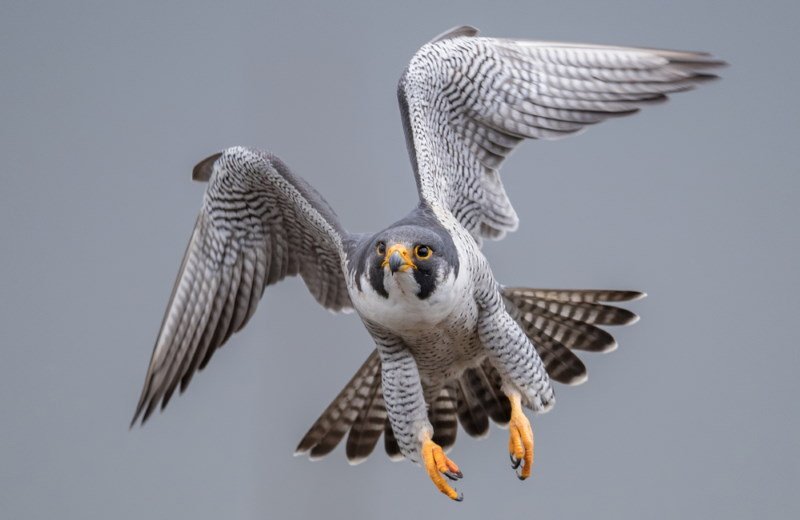
The fastest bird in the world is the Peregrine Falcon. By folding its wings tightly against its body and dropping like a stone, it reaches speeds of up to 389 kilometers per hour in a dive. If we look purely at who can fly the fastest under their own muscle power (without falling), the White-throated Needletail wins at 169 km/h.
Birds are the absolute masters of speed. While land animals have to deal with friction from the ground and obstacles, birds have the open sky.
Still, not every bird is the same. Some use gravity to shoot down like a rocket (really a controlled fall), while others have enormous muscle power to seemingly break the sound barrier horizontally. And let's not forget the runners, because birds are surprisingly fast on the ground too.
Here are nature's 10 fastest pilots.
Cast your vote - the ranking shifts live based on the votes.
Peregrine Falcon (389 km/h - Dive)
The undisputed number one. The peregrine falcon is built for hunting at high altitude. Its nostrils even have special baffles to cope with the enormous air pressure at 300+ km/h; otherwise its lungs would burst. Dutch bird protection society Vogelbescherming explains that this bird of prey is increasingly seen in the Netherlands, even in cities where they nest on tall buildings and hunt pigeons.
https://www.youtube.com/shorts/SVkK-uv1S2A
Golden Eagle (320 km/h - Dive)
The golden eagle is hardly inferior to the peregrine falcon. It is, however, much larger and heavier. Where the peregrine is a precision instrument, the golden eagle is a flying wrecking ball. It uses its diving speed to surprise prey that is sometimes larger than itself, such as foxes or even young deer.
Log in to post a comment.
Gyrfalcon (209 km/h - Hunting Flight)
This is the largest falcon species in the world. It lives in the cold regions around the North Pole. Unlike the peregrine, which stops flapping during the dive, the gyrfalcon often keeps pumping its wings to build speed. It is the terror of the north; hardly any bird can escape it.
Log in to post a comment.
White-throated Needletail (169 km/h - Level Flight)
This is where it gets interesting. If we rule out “cheating” with gravity (diving), this is the fastest bird. This swift, recognizable by the little spines on its tail feathers, flies faster than a car on the highway on pure muscle power. Experts at the National Audubon Society call swifts the most aerodynamic birds in existence; they even sleep and mate in the air.
Log in to post a comment.
Eurasian Hobby (160 km/h)
A smaller cousin of the peregrine, but extremely agile. The hobby is so fast and nimble that it can catch other fast fliers, such as swallows and even dragonflies. It often grabs its prey with its feet and eats it in flight without landing.
Log in to post a comment.
Frigatebird (153 km/h)
These seabirds have the largest wing area relative to body weight of any bird. They are made to soar for weeks, but can accelerate bizarrely fast during a chase. They are known as 'pirates' (kleptoparasites): they harass other birds until they drop their caught fish in fright.
Log in to post a comment.
Spur-winged Goose (142 km/h)
A goose? Yes, really. The spur-winged goose from Africa is the largest waterfowl in the world and a surprising speed demon. It is a heavy bird that needs quite a runway to take off, but once airborne it is unstoppable. Be careful though: Encyclopædia Britannica warns that the meat of this goose can be poisonous to humans, because it eats toxic beetles.
Log in to post a comment.
Red-breasted Merganser (130 km/h)
Another waterfowl on the list. The red-breasted merganser has a streamlined body and a serrated bill for catching slippery fish. During migration they often fly low over the water, reaching speeds that would make an average motorboat jealous.
Log in to post a comment.
Grey-headed Albatross (127 km/h)
Albatrosses are known as gliders, but the grey-headed albatross has some serious skills. Guinness World Records noted that this bird holds the record for the highest sustained speed: one individual flew for more than 8 hours at an average of 127 km/h during a storm over Antarctica.
Log in to post a comment.
Ostrich (70 km/h - On Land)
We end the list on the ground. The ostrich can't fly, but it is the fastest bird on two legs. With its huge, muscular thighs it takes strides of 3 to 5 meters. It can easily keep up this speed for half an hour, leaving lions and hyenas in the dust during a long chase.
Log in to post a comment.
Missing an item in this list?
Log in or create a free account to add an item yourself.
Log in / create account
Log in to post a comment.