


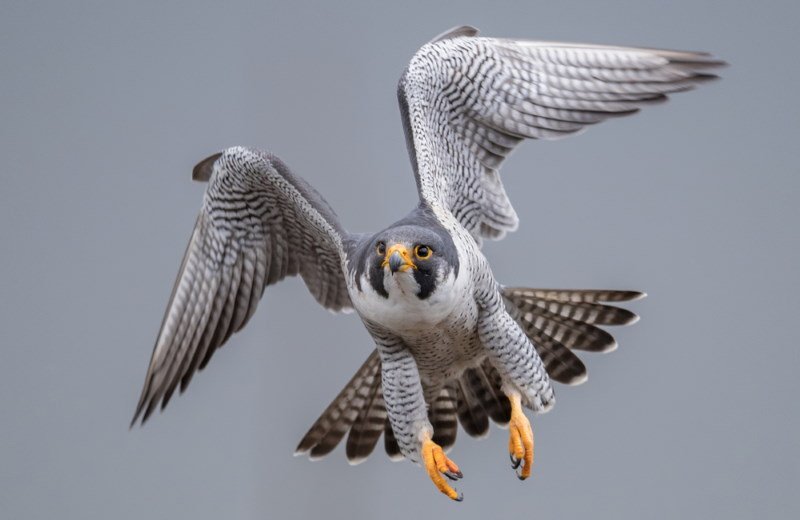
The absolute king of velocity is the Peregrine Falcon. While many animals rely on muscle power to sprint, the Peregrine uses the laws of physics. During its signature hunting maneuver, known as a stoop, this raptor reaches a verified top speed of 389 kilometers per hour (242 mph). To put that in perspective, that is faster than a high-speed bullet train and nearly as fast as the world’s most powerful supercars.
Speed in the natural world is rarely about bragging rights; it is usually a desperate race for survival. Whether you are a predator trying to secure a meal or prey attempting to avoid becoming one, every fraction of a second counts. Evolution has engineered some truly bizarre solutions to the problem of drag and friction. From birds that have built-in jet engine mechanics in their nostrils to insects that run so fast they literally go blind, the animal kingdom is a high-speed laboratory of extreme engineering.
1. Peregrine Falcon (389 km/h)
The Peregrine Falcon is not just fast; it is an aerodynamic masterpiece. When it spots prey from a mile up, it tucks its wings and enters a gravitational freefall. At nearly 400 km/h, the air pressure alone could burst a human’s lungs. However, the Peregrine has evolved small, bony tubercles in its nostrils that redirect the airflow, allowing it to breathe even at terminal velocity. Its eyes are equipped with a third eyelid—a nictitating membrane—that acts like goggles to clear debris and keep the eye moist during the dive. When it hits its target, usually a pigeon or duck, the impact is often enough to kill the prey instantly. You can read more about their incredible recovery from the brink of extinction on the IFAW website.
2. Golden Eagle (322 km/h)
While the Peregrine is a precision instrument, the Golden Eagle is a heavy-duty brawler. It is significantly larger and more powerful, yet it still manages to hit speeds over 300 km/h during a dive. What makes the Golden Eagle terrifying is its versatility. It doesn’t just hunt birds; it has been known to take down mountain goats and even small deer by using its massive momentum to knock them off cliffs. Its talons can exert a crushing force that is fifteen times stronger than a human hand, making it one of the most successful apex predators in the Northern Hemisphere.
3. White-throated Needletail (170 km/h)
Here is where we separate the ‘divers’ from the ‘flyers.’ If we ignore the help of gravity, the White-throated Needletail is arguably the fastest bird in the sky. This swift can reach 170 km/h in pure horizontal flight using nothing but its own muscle power. Their bodies are shaped like cigars, minimizing drag, and they spend almost their entire lives in the air. They eat, drink, and even sleep while flying. According to data from Britannica, these birds are the Ferraris of the avian world, built for sustained, high-octane travel across continents.
4. Mexican Free-tailed Bat (160 km/h)
For a long time, birds dominated the speed charts, but recently, a small mammal crashed the party. The Mexican Free-tailed Bat has been clocked at 160 km/h in level flight. This is staggering because bats are generally considered less aerodynamic than birds. These bats have long, narrow wings that are perfectly adapted for high-speed travel. They live in massive colonies—some numbering in the millions—and their evening exodus from caves like the Bracken Cave in Texas is a sight that rivals any major sporting event in terms of coordinated movement and sheer numbers.
5. Eurasian Hobby (160 km/h)
This small, elegant falcon is the nightmare of the dragonfly and the swift. It is so fast and agile that it can catch insects and even other small birds in mid-air. The Hobby often eats its prey while still on the wing, using its nimble feet to bring the food up to its beak. It is a specialist of the summer skies, often seen hunting during the ‘golden hour’ when its prey is most active. Its wings are particularly long and pointed, giving it the silhouette of a giant swift.
6. Horsefly (145 km/h)
It sounds like a tall tale, but the common Horsefly is a certified speed demon. Certain species have been recorded at speeds nearly reaching 150 km/h. While scientists continue to debate the absolute top speeds of insects due to measurement difficulties, the sheer acceleration of a horsefly is undeniable. They need this speed to keep up with the fast-moving mammals they feed on. If you’ve ever wondered why you can’t seem to swat them away, it’s because their reaction times and flight speeds are literally beyond human capability.
7. Black Marlin (129 km/h)
Leaving the sky and diving into the ocean, we find the Black Marlin. It is the undisputed Formula 1 car of the sea. Anglers have reported these fish stripping line off a reel at a rate that suggests speeds of 130 km/h. They have a sword-like bill used to stun prey and a rigid body that allows them to cut through the water with minimal turbulence. Interestingly, the Marlin’s speed is so high that it faces the problem of cavitation—where the water pressure drops so low it creates bubbles that can damage the fish’s skin. Deep dives into marine biology on National Geographic show that these giants are truly built for the open ocean chase.
8. Cheetah (120 km/h)
The Cheetah is nature’s ultimate dragster. It can go from 0 to 100 km/h in just three seconds, which is faster than most high-end sports cars. Every part of its body is tuned for this sprint. Its semi-retractable claws act like the spikes on a track shoe, providing immense grip. Its long tail serves as a rudder, allowing it to make sharp turns at high speeds without flipping over. However, this extreme performance comes at a cost. The Cheetah can only maintain its top speed for about 30 seconds before its body temperature rises to dangerous levels, forcing it to stop and rest.
9. Sailfish (110 km/h)
Often confused with the Marlin, the Sailfish is recognized by its massive dorsal fin. While slightly slower than the Marlin, it is more agile. It often hunts in packs, using its ‘sail’ to herd schools of fish into tight balls before striking. The Sailfish can also change its skin color almost instantly, using vibrant flashes of blue and purple to confuse its prey and communicate with other hunters in the pack. It is a master of the sprint, often leaping out of the water in a display of raw power.
10. Pronghorn (89 km/h)
The Pronghorn is the marathon runner of the group. While the Cheetah is faster in a short burst, the Pronghorn would win any long-distance race. It can maintain a speed of 60 km/h for miles. This animal evolved in North America alongside predators that are now extinct, such as the American Cheetah. Because those predators died out, the Pronghorn is now “over-evolved”—it is much faster than any current predator in its environment, including wolves and cougars. Its oversized windpipe and heart allow it to process massive amounts of oxygen, fueling its legendary endurance.
“10 Largest Animals in the World (by Species)
