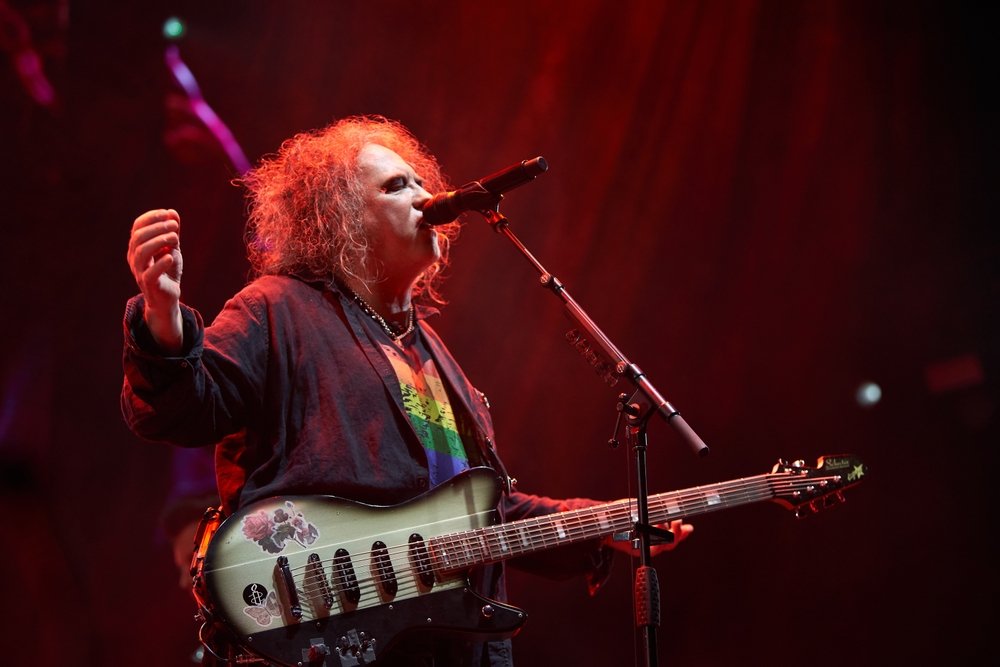
Formed in Crawley, West Sussex, in 1978, The Cure, anchored by visionary frontman, songwriter, and guitarist Robert Smith with his trademark bird’s-nest hair, smudged red lipstick, and oversized black cardigan, stand as the undisputed icons of gothic rock and atmospheric alternative pop.
Yet while their gloomy post-punk landscapes and existential introspection earned them a devoted cult following, The Cure’s genius lay in Smith’s extraordinary melodic versatility.
10. The Lovecats
Released as a standalone single in October 1983, “The Lovecats” demonstrated Robert Smith’s playful, eccentric genius. Shaking off the suffocating gloom of Pornography, Smith composed a bouncy, jazz-infused pop masterpiece driven by Phil Thornalley’s walking double bass, swinging vibraphone accents, and Smith’s whimsical, feline vocal purrs and hisses: “We’re so wonderfully, wonderfully, wonderfully, wonderfully pretty!”
Reaching number seven on the UK Singles Chart, it became The Cure’s historic first Top 10 hit, proving they could conquer pop charts with theatrical charm.
9. Friday I’m in Love
Proof that gothic rock’s preeminent doom-thinker could craft the happiest, most infectious pop song on the planet, “Friday I’m in Love” from 1992’s Wish is a burst of pure euphoria. Robert Smith famously wrote the chord progression in a sudden fit of creative joy, so astonished by how naturally the melody arrived that he spent days calling producer David M.
Allen to ask if he had accidentally stolen it from someone else.
8. Pictures of You
Clocking in at over seven glorious, atmospheric minutes on 1989’s gothic magnum opus Disintegration, “Pictures of You” was born from a tragic real-life event: a physical fire broke out in Robert Smith’s home, and while sifting through the charred ruins, he discovered his surviving wallet containing old, singed photographs of his beloved wife Mary Poole. Building slowly through shimmering guitar textures, wind chimes, and Simon Gallup’s deep bass pulses, Smith laments the agonizing realization of taking true love for granted: “If only I’d thought of the right words / I wouldn’t be breaking apart all my pictures of you.”
It is romantic melancholy elevated to high art.
7. In Between Days
The sparkling lead single from 1985’s The Head on the Door, “In Between Days” (often affectionately known as “Inbetween Days”) is a brilliant study in emotional contrast. Driven by a brisk, strummed 12-string acoustic guitar and bouncy synthesizer hooks that invite immediate dancing, Robert Smith sings of the terrifying realization of aging, romantic doubt, and fading youth: “Yesterday I got so old / I felt like I could die.”
The contrast between the breezy, New Order-influenced indie-pop tempo and existential lyrics became a classic Cure trademark.
6. Close to Me
A claustrophobic pop marvel, “Close to Me” achieves maximum emotional intimacy through minimalist instrumentation. Built around Simon Gallup’s funky, repetitive bass groove, an electronic drum beat, and Smith’s audible, heavy breathing into the studio microphone, the song captures the paralyzing anxiety and awkward vulnerability of emotional closeness.
Accompanied by Tim Pope’s legendary music video, featuring all five band members crammed inside a wardrobe that topples off the cliffs of Beachy Head into the sea, it remains one of their most beloved and playful classics.
5. Boys Don’t Cry
Released in 1979 as the band’s second single, “Boys Don’t Cry” is a timeless post-punk classic. Driven by a bright, chiming three-chord guitar riff and a bouncy tempo, Robert Smith subverts traditional masculine stoicism, chronicling the agony of male pride forbidding someone from showing tears or vulnerability after breaking a partner’s heart: “I try to laugh about it / Cover it all up with lies / I try to laugh about it / Hiding the tears in my eyes / ‘Cause boys don’t cry.”
Its innocent charm and melodic perfection have made it an immortal indie anthem.
4. Just Like Heaven
Widely regarded by music critics as the classic alternative pop song, “Just Like Heaven” from 1987’s Kiss Me, Kiss Me, Kiss Me is pure, breathless romantic magic. Inspired by a dreamy day trip Robert Smith took to Beachy Head with his future wife Mary, the track enters layer by layer: Boris Williams’s crisp drum intro, Simon Gallup’s descending bassline, Porl Thompson’s sparkling guitar arpeggios, and Smith’s rapturous vocal delivery: “Show me, show me, show me how you do that trick / The one that makes me scream, she said.”
When the instrumentation suddenly cuts off at the end, it feels like waking from a dream.
3. Lovesong
Written by Robert Smith as a deeply personal wedding gift for Mary Poole before their marriage in August 1988, “Lovesong” is one of the most pure and moving declarations of devotion in music history. Designed to comfort Mary while Smith was constantly touring overseas, the lyrics are direct and devoid of cynical defense: “Whenever I’m alone with you / You make me feel like I am home again / However far away, I will always love you.”
Layered with melancholic string synthesizers and an intricate bass hook, the song soared to number two on the US Billboard Hot 100, later inspiring a multi-platinum cover by Adele.
2. Lullaby
A whispering, nocturnal gothic nightmare, “Lullaby” from 1989’s Disintegration is The Cure at their most delightfully theatrical and creepy. Driven by delicate, plucked pizzicato string arrangements that sound like spider legs crawling across your bare skin, and Simon Gallup’s sultry bassline, Smith delivers hushed, spoken-word verses about being devoured in his bed by a sinister “Spiderman.”
Accompanied by Tim Pope’s award-winning music video where Smith is swallowed by a giant arachnid, the song reached number five on the UK Singles Chart.
1. A Forest
The undisputed, foundational pillar of gothic rock, “A Forest” from 1980’s Seventeen Seconds is The Cure’s dark masterpiece. Building layer upon layer over an iconic two-minute instrumental introduction, Lol Tolhurst’s cold metronomic drumbeat, Simon Gallup’s ominous rumbling bassline, and Robert Smith’s chilling, flanged guitar chords, the track pulls listeners into a terrifying psychological maze.
Smith sings of chasing an imaginary girl deeper and deeper into a dark forest, only to find nothingness: “Suddenly I stop / But I know it’s too late / I’m lost in a forest / All alone.” Hypnotic, cold, and extraordinary, it remains The Cure’s ultimate musical statement.
Which choice on this list is your personal favorite? Share your thoughts and rankings in the comments below.