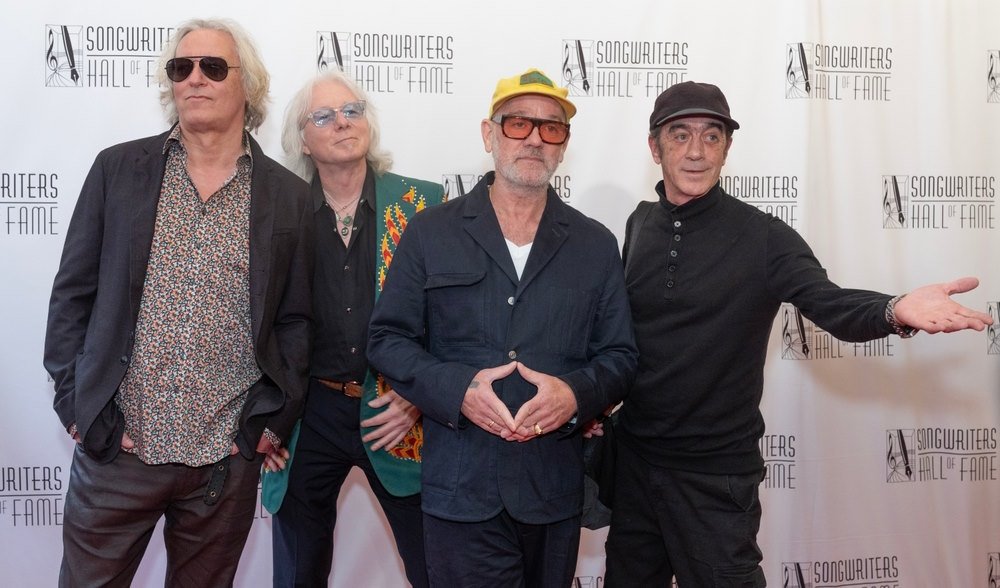
R.E.M. was the foundational architect, moral compass, and definitive champion of American alternative rock.
Emerging from the college town of Athens, Georgia, in 1980, the quartet of enigmatic frontman Michael Stipe, arpeggiated Rickenbacker guitar maestro Peter Buck, melodic bassist Mike Mills, and force drummer Bill Berry forged a revolutionary sonic path.
10. Orange Crush
The blistering centerpiece of their 1988 major-label debut Green, “Orange Crush” is a fierce, stadium-sized anti-war rock anthem. Michael Stipe was inspired by his father, who served in the Vietnam War, and the devastating, toxic legacy of the chemical defoliant Agent Orange used by the US military: “Follow me, don’t follow me / I’ve got my spine, I’ve got my orange crush.”
Driven by Bill Berry’s thunderous, marching snare groove and Peter Buck’s aggressive, chugging guitar riffs, Stipe delivers his impassioned vocals through a distorted megaphone. Mike Mills provides soaring, melodic counter-vocals that elevate the chorus to euphoric heights.
9. Find the River
Serving as the striking, pastoral closing hymn of their 1992 masterpiece Automatic for the People, “Find the River” is a serene meditation on mortality, aging, and spiritual acceptance. Stipe uses botanical metaphors of bergamot, vetiver, and coriander to chronicle the journey of a river flowing inevitably into the vast, boundless ocean.
Mike Mills’s gentle acoustic piano, Peter Buck’s 12-string acoustic guitar, and Bill Berry’s subtle percussion support Stipe’s tender, cracked vocal.
8. It’s the End of the World as We Know It (And I Feel Fine)
Michael Stipe rattles off a breathless, rapid-fire avalanche of political figures, Cold War anxiety, media overload, and pop-culture references (Leonard Bernstein, Leonid Brezhnev, Lenny Bruce, and Lester Bangs). Propelled by Bill Berry’s driving punk tempo, Peter Buck’s frantic acoustic strumming, and Mike Mills’s buoyant backing vocals, the song transforms societal dread into pure, cathartic joy: “It’s the end of the world as we know it, and I feel fine!”
It has become an eternal cultural touchstone during moments of global upheaval.
7. Nightswimming
The song completely dispenses with drums and electric guitars: the entire arrangement rests upon Mike Mills’s rolling, lyrical grand piano progression, John Paul Jones’s (Led Zeppelin) sublime orchestral string arrangement, and Deborah Workman’s haunting oboe solo. Stipe delivers one of the most tender, heartbreaking vocal performances of his life, reminiscing about late-night skinny-dipping in the murky quarries of Athens, Georgia, with bandmates and friends in their youth: “Nightswimming deserves a quiet night / The photograph on the dashboard taken years ago.”
It is a timeless elegy to fleeting youth and lost innocence.
6. Shiny Happy People
The infectious second single from 1991’s diamond-certified Out of Time, “Shiny Happy People” is one of the most misunderstood songs in rock history. While often dismissed as bubblegum pop, Stipe actually wrote the lyrics as a biting, satirical parody of totalitarian Chinese Communist Party propaganda posters printed in the wake of the 1989 Tiananmen Square massacre.
Featuring exuberant guest vocals from Kate Pierson of fellow Athens legends The B-52’s, sweeping string arrangements, and jangling 12-string guitars, the track was an irresistible international pop sensation.
5. Man on the Moon
Written in loving tribute to subversive avant-garde comedian and performance artist Andy Kaufman, “Man on the Moon” was the final song written for 1992’s Automatic for the People. Stipe struggled for months to write lyrics until the very final day of mixing in Seattle, spontaneously penning a meditation on conspiracy theories, moon landings, wrestling matches, and Kaufman’s playful deception of reality.
The song features Peter Buck playing a vintage slide guitar and Mike Mills delivering a signature warm acoustic bass groove.
4. The One I Love
The breakthrough single that catapulted R.E.M. into mainstream commercial stardom in 1987, “The One I Love” reached number nine on the Billboard Hot 100. Despite often being mistaken for a romantic dedication and played at weddings, Stipe’s lyrics are brutally cynical, describing a user discarding a partner: “This one goes out to the one I love / This one goes out to the one I’ve left behind / A simple prop to occupy my time.”
Peter Buck crafts one of the most famous guitar riffs in alternative rock history: a ringing, arpeggiated riff that roars through a cranked amplifier, anchored by Bill Berry’s punchy kick drum and Mike Mills’s soaring falsetto counterpoint on the word “Fire!”
3. Drive
The brooding, atmospheric lead single from 1992’s Automatic for the People, “Drive” was an audacious artistic gamble. Following the colossal pop success of “Losing My Religion,” Warner Bros. expected another upbeat radio hit; instead, R.E.M. returned with a dark, slow-burning acoustic dirge about youth disenfranchisement.
Borrowing the opening lyric from David Essex’s 1973 glam hit “Rock On” (“Hey kids, rock and roll…”), the song builds with menacing tension.
2. Everybody Hurts
Written primarily by drummer Bill Berry, “Everybody Hurts” was deliberately constructed with direct, unadorned simplicity to reach suicidal teenagers struggling in isolation. Setting aside Stipe’s customary poetic obliqueness, the song offers an unconditional emotional lifeline: “When your day is long and the night, the night is yours alone…
Don’t let yourself go / ‘Cause everybody cries, and everybody hurts sometimes.” Arranged as a slow 6/8 soul waltz with John Paul Jones’s soaring strings and Mike Mills’s delicate organ, Stipe’s vocal delivery is an extraordinary achievement of human empathy and compassion.
1. Losing My Religion
The unlikely, world-conquering masterpiece that transformed R.E.M. into global legends: “Losing My Religion” began with Peter Buck sitting on a sofa watching television while practicing a newly purchased mandolin, inadvertently stumbling upon an infectious, minor-key riff. Warner Bros. executives initially refused to release it as the lead single from 1991’s Out of Time, arguing that a five-minute song driven by a mandolin with no discernible chorus would be commercial suicide.
They could not have been more wrong. The song takes its title from an old Southern American idiom meaning “losing one’s temper, patience, or civility.”
Which choice on this list is your personal favorite? Share your thoughts and rankings in the comments below.