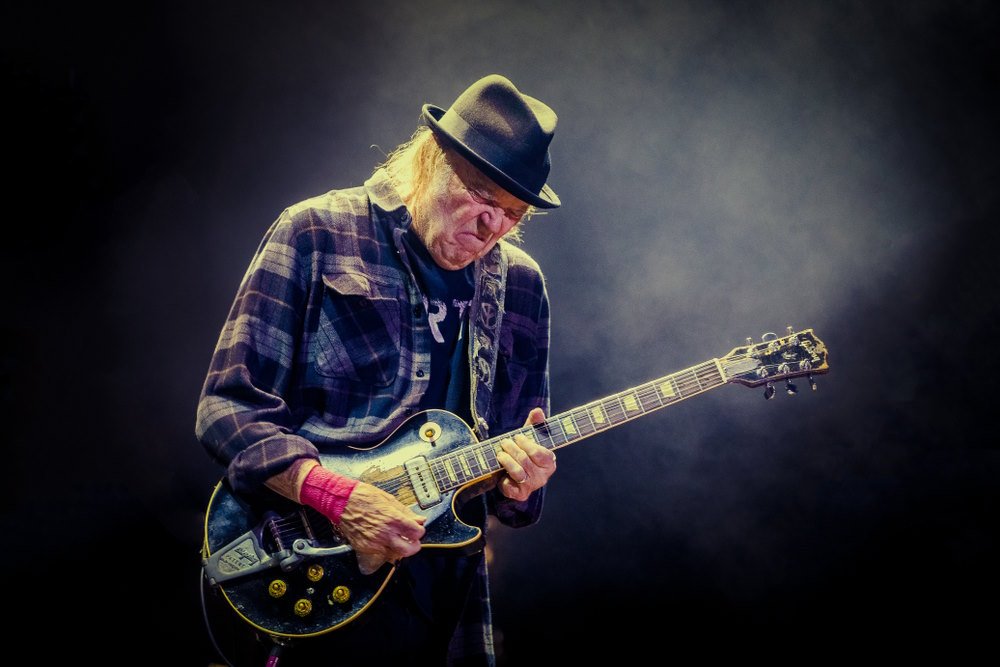
Few artists in the history of rock and roll have embodied the restless, uncompromising spirit of artistic freedom, raw sonic fury, and delicate acoustic beauty quite like Canadian singer-songwriter Neil Percival Young.
Known universally as “The Godfather of Grunge,” Young first rose to prominence with Buffalo Springfield and Crosby, Stills, Nash & Young before forging an idiosyncratic, six-decade solo career alongside his legendary backing band Crazy Horse.
10. Down by the River
Featured on his landmark 1969 sophomore album Everybody Knows This Is Nowhere, “Down by the River” was famously written by Young while bedridden with a 103-degree fever in his Topanga Canyon home (on the same day he wrote “Cowgirl in the Sand” and “Cinnamon Girl”). Clocking in at over nine magnificent minutes, the song is a dark, allegorical murder ballad about killing an emotional bond that has become unbearable: “Down by the river / I shot my baby / Down by the river / Dead, shot her dead.”
The song features an extraordinary, rambling guitar dialogue between Neil Young’s stinging lead lines and Danny Whitten’s rhythm guitar, trading sharp staccato stabs and howling feedback over Billy Talbot and Ralph Molina’s hypnotic rhythm pocket.
9. Southern Man
The searing centerpiece of 1970’s After the Gold Rush, “Southern Man” is an uncompromising indictment of racism, white supremacy, and lynchings in the American South. Young pulls zero punches, directly confronting the hypocrisy of slaveholding history: “Southern man, better keep your head / Don’t forget what your good book said / Southern change gonna come at last / Now your crosses are burning fast.”
The song is driven by Nils Lofgren’s driving piano chords, Greg Reeves’ bass, and Young’s blistering, incendiary guitar solos that cut like a buzzsaw.
8. Harvest Moon
The title track of his beloved 1992 acoustic album, “Harvest Moon” is one of the most tender and enduring love songs ever written. Dedicated to his wife Pegi Young, the song celebrates enduring romantic love that has survived decades of life’s storms: “Because I’m still in love with you / I want to see you dance tonight / Let’s go out and feel the night / When the harvest moon is on the rise.”
Built upon gentle acoustic guitar harmonics, Ben Keith’s weeping pedal steel guitar, and Linda Ronstadt’s soaring backing harmonies, the track features sound engineer Kenny Buttrey playing a broom gently brushed across a sheet of cardboard to generate the rhythmic pulse.
7. Cinnamon Girl
The explosive opening track of Everybody Knows This Is Nowhere, “Cinnamon Girl” introduced Neil Young’s signature drop-D guitar tuning (specifically “Double Drop-D” where both E strings are tuned down to D). Built around a heavy, crunching rhythm riff that practically invented grunge, the song is famous for its revolutionary, single-note guitar solo, where Young plays a single D note with ferocious rhythmic nuance for sixteen bars.
Singing of an idealized dream girl who can wash away the troubles of the world, Young’s vocals harmonize with Danny Whitten’s tenor over driving Crazy Horse groove. It remains one of the greatest garage-rock riffs in recorded music.
6. The Needle and the Damage Done
Clocking in at barely two minutes, “The Needle and the Damage Done” from 1972’s Harvest (recorded live at UCLA’s Royce Hall in 1971) is a devastating, acoustic lament for the friends Young lost to heroin addiction, most notably Crazy Horse guitarist Danny Whitten. Over a descending acoustic guitar progression, Young observes the tragic slow-motion suicide of addiction with heartbreaking brevity: “I’ve seen the needle and the damage done / A little part of it in everyone / But every junkie’s like a settin’ sun.”
Lacking any drums or electric instruments, Young’s quavering, high tenor voice delivers one of the most chilling and compassionate anti-drug warnings ever committed to tape.
5. Cortez the Killer
Featured on 1975’s Zuma, “Cortez the Killer” is a majestic, slow-moving psychedelic rock masterpiece chronicling Spanish conquistador Hernán Cortés and the tragic destruction of the Aztec empire under Montezuma: “He came dancing across the water / With his galleons and guns / Looking for the new world / In that palace in the sun.” In a famous studio incident, an electrical power cut abruptly terminated the recording take before Young could sing the final verse; Young famously shrugged and told the engineer, “I never liked that verse anyway,” leaving the song with its immortal, lingering guitar fadeout.
Built upon an undulating Em7-D-Am7 chord cycle, Young’s weeping, distorted guitar playing is pure poetry.
4. Like a Hurricane
Written by Young in July 1975 in the back of his friend Taylor Phelps’ car after undergoing throat surgery that prevented him from singing, “Like a Hurricane” was released on 1977’s American Stars ‘n Bars. Stretching over eight minutes of volcanic guitar fury, the song features Young attacking “Old Black” through an overdriven Fender Deluxe amplifier, weaving ferocious squalls of feedback that mimic a tropical cyclone.
Anchored by Frank “Poncho” Sampedro’s soaring Stringman synthesizer and Crazy Horse’s immovable rhythm section, Young screams of all-consuming, disorienting romantic obsession: “You are like a hurricane / There’s calm in your eye / And I’m gettin’ blown away / To somewhere safer where the feeling stays.”
3. Rockin’ in the Free World
Serving as the opening acoustic track and closing electric blast on his 1989 comeback album Freedom, “Rockin’ in the Free World” was written by Young after learning that a planned tour of the Soviet Union had been canceled, with Poncho Sampedro remarking: “We’ll just have to keep on rockin’ in the free world.” Young took that phrase and transformed it into a blistering, sarcastic indictment of poverty, drug addiction, and environmental neglect under the Reagan-Bush administration.
Featuring a ferocious, distorted guitar assault and Young’s snarling vocal delivery, the anthem, “Keep on rockin’ in the free world!”, was embraced worldwide as an anthem of freedom during the fall of the Berlin Wall, later famously covered by Pearl Jam and cementing Young’s title as the Godfather of Grunge.
2. Heart of Gold
Neil Young’s only number-one single on the US Billboard Hot 100, “Heart of Gold” was recorded during the 1971 sessions for Harvest in Nashville. Suffering from severe back injury that prevented him from standing with a heavy electric guitar, Young sat down with his acoustic guitar, a harmonica rack, and an aching heart, writing a tender quest for emotional purity: “I want to live, I want to give / I’ve been a miner for a heart of gold / It’s these expressions I never give / That keep me searching for a heart of gold / And I’m getting old.”
Highlighted by James Taylor and Linda Ronstadt’s sublime backing vocal harmonies and Ben Keith’s gentle pedal steel, the song became a global phenomenon.
1. Old Man
Written by Neil Young for Louis Avila, the elderly caretaker of the 140-acre Broken Arrow Ranch in Northern California that Young purchased in 1970 for $350,000, “Old Man” is an immortal masterpiece of generational empathy and human connection. Young reflects on the universal truth that beneath the differences in age, a young man and an old man share the exact same need for love and companion: “Old man, look at my life / I’m a lot like you were / Old man, look at my life / Twenty-four and there’s so much more / Live alone in a paradise / That makes me think of two / Love lost, such a cost / Give me things that don’t get lost.”
Driven by James Taylor’s delicate six-string banjo playing, Linda Ronstadt’s backing vocals, and Young’s poignant acoustic strumming, the song reached number 31 on the Billboard Hot 100 and remains permanently etched in the cultural consciousness.
Which choice on this list is your personal favorite? Share your thoughts and rankings in the comments below.