


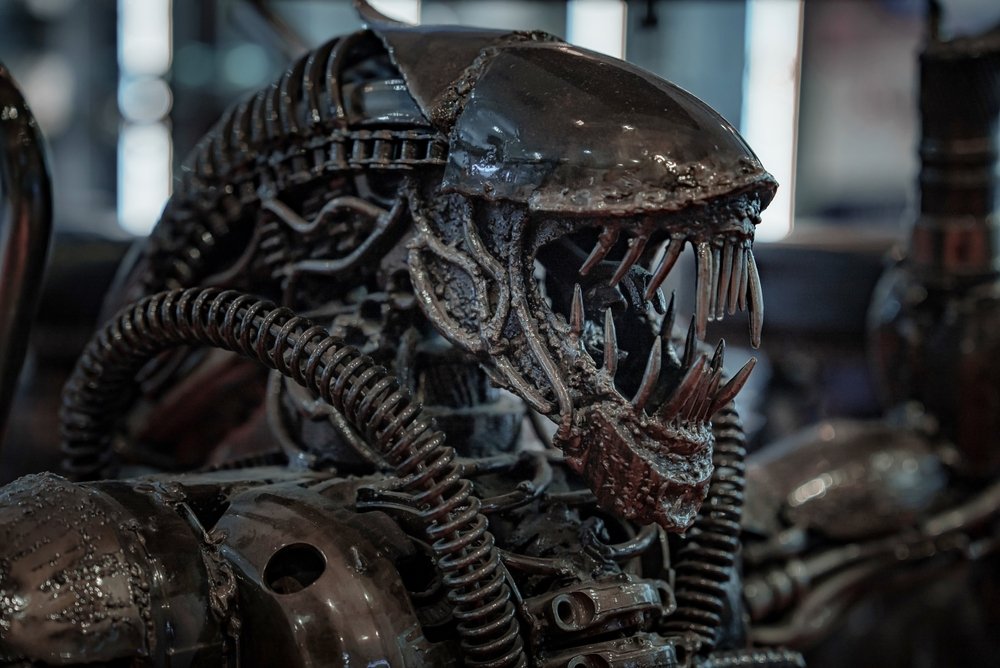
Alien is one of the most influential science-fiction horror franchises in cinematic history. It began with Ridley Scott’s claustrophobic vision and grew into an epic that has influenced generations of filmmakers. The series explores humanity’s deepest fears in the infinite void of space. Below is an extensive ranking of the nine films, from the least successful to the undisputed masterpiece.
9. Alien vs. Predator: Requiem (2007)
This sequel by the Strause brothers is often considered the low point of the series. The story picks up where the previous installment ended, with a hybrid between an Alien and a Predator crashing in a small town in Colorado. Although the film attempted to return to a more mature tone with an R-rating, the execution failed on almost every technical level.
The biggest criticism is the lighting; the film is so dark that the action is simply invisible at many moments. The human characters are one-dimensional and serve only as food for the monsters. Although the Predalien has an interesting design, it does not come to its own due to the poor cinematography. The film still grossed 128 million dollars worldwide, but the negative reception ensured that the crossover branch of the franchise was shut down for a long time.
8. Alien vs. Predator (2004)
Paul W.S. Anderson brought the two most iconic monsters of space together in a battle beneath the ice of Antarctica. A team of scientists discovers an ancient pyramid where Predators breed young Xenomorphs as part of a rite of passage. The concept is intriguing; the execution, however, often feels more like a theme park attraction than a true horror film.
The choice for a PG-13 rating removed the sharp edges of the violence, which disappointed many fans of the original series. The battles between the creatures are entertaining, but the human characters remain superficial.
7. Alien: Resurrection (1997)
Two centuries after the events on the prison planet, Ripley is cloned to extract the queen from her body. Director Jean-Pierre Jeunet brought his unique, surreal style to the franchise, resulting in a film that is visually stunning but misses the mark regarding tone. The film balances between black humor and grotesque horror.
The script, written by Joss Whedon, introduces a group of mercenaries trying to survive on a space station full of escaped creatures. The introduction of the Newborn, a hybrid between human and Alien, is one of the most controversial choices in the history of the series. Although the film contains innovative scenes, such as the underwater chase, the whole often feels too eccentric to be truly terrifying.
6. Alien 3 (1992)
The production of this installment was a true nightmare for director David Fincher, who eventually turned his back on the film. The story begins with a shocking twist: the survival of the previous installment is immediately undone, leaving many viewers furious. Ripley ends up on a bleak prison planet where she must fight a single Xenomorph alongside the inmates.
Despite the problems behind the scenes, the film possesses a strong, nihilistic atmosphere. The Assembly Cut, released later, restores much of Fincher’s vision and offers more depth to the characters. It is a film about sacrifice and religion, wrapped in a somber aesthetic. Although it did not meet high expectations at the time, it is now appreciated for its bold choices and visual power.
5. Prometheus (2012)
Ridley Scott returned after decades to the universe he helped create. Instead of a direct horror film, he opted for a philosophical epic about the origins of humanity. A team of scientists travels to a distant moon to meet the Engineers, the beings who possibly created us.
The film excels in visual splendor, and Michael Fassbender’s performance as the android David is phenomenal. However, the script leaves many questions unanswered, and the characters sometimes make incomprehensible choices.
4. Alien: Covenant (2017)
This sequel to the prequel sought to combine the philosophy of its predecessor with the classic horror of the original. We follow a colony ship that lands on a seemingly paradisiacal planet, where they encounter the remaining David. The film explores the android’s obsession with creation and perfection, leading to the birth of the Xenomorph as we know it.
The introduction of the Neomorphs and the brutal killings provide a return to the bloody roots of the series. It is a dark and ruthless story that shows how dangerous artificial intelligence can be when it develops a god complex. Although the plot is somewhat predictable at times, it offers several rock-solid horror moments and an unforgettable finale.
3. Alien: Romulus (2024)
Fede Álvarez impressively brought the franchise back to its core. Set between the first two installments, the film follows a group of young colonists trying to scavenge a deserted space station. What they find is a nightmare that harkens back to the practical effects and claustrophobia of the early years.
The film makes clever use of existing mythology while introducing new, terrifying elements. The focus on tangible monsters and physical sets provides a realism that was sometimes missing in later installments. It is a tribute to the past that also paves the way for a new future.
2. Aliens (1986)
James Cameron took over and transformed the franchise from pure horror into an explosive action film. Ripley returns to the planet where it all began, this time accompanied by a unit of Colonial Marines. The film introduces the Alien Queen, a visual masterpiece that still impresses today.
The pacing is breakneck, and the characters are all memorable. The battle between Ripley in her Power Loader and the queen is one of the most iconic moments in film history. Cameron succeeded in increasing the scale without losing the tension. It is a perfect example of a sequel that expands the mythology while assuming an entirely unique identity.
1. Alien (1979)
Ridley Scott’s original remains unbeatable. With an unprecedented mastery of pacing, shadow, and sound, he created the ultimate science-fiction horror experience. The crew of the Nostromo is not a group of heroes, but ordinary workers faced with an unimaginable threat. The designs by H.R. Giger gave the monster a unique, biomechanical appearance that touches the viewer to their soul.
The infamous dinner scene changed the genre forever; the actors’ reactions were real, contributing to the raw impact. Ripley grew into one of the strongest female characters ever and proved that you don’t have to fight with weapons alone to survive. It is a film about isolation and the unknown, where every detail contributes to the oppressive atmosphere. Without this masterpiece, the landscape of modern film would have looked very different.
