
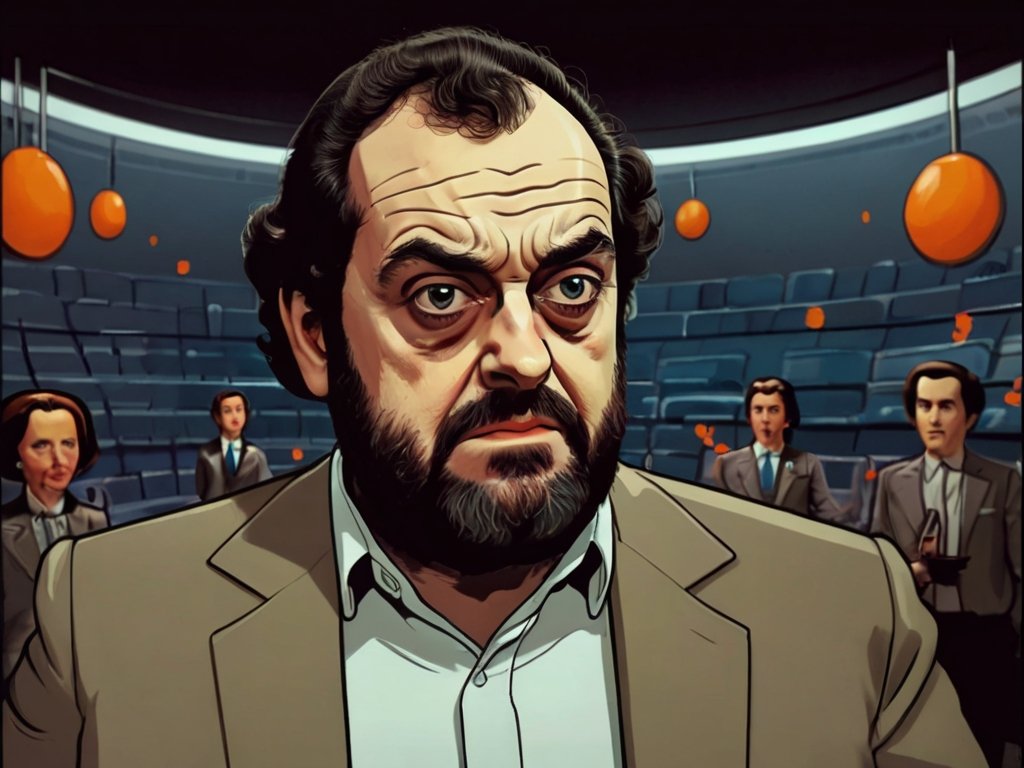
Stanley Kubrick made only 13 feature films before his death in 1999. Each is groundbreaking in its own way, exploring diverse genres and themes. Here's an overview of all 13 films in his body of work.
Cast your vote - the ranking shifts live based on the votes.
2001: A Space Odyssey (1968)
Kubrick's epic science fiction masterpiece follows humanity from the dawn of civilization to interplanetary travel. Known for its groundbreaking effects, philosophical depth and minimal dialogue, co-written with Arthur C. Clarke, it explores human evolution, artificial intelligence and the unknown.
Dr. Strangelove or: How I Learned to Stop Worrying and Love the Bomb (1964)
A black comedy about the Cold War and the threat of nuclear annihilation. Peter Sellers plays three roles in this satire of political and military incompetence. Hilarious and sharp, it skewers the absurdity of the power structures that ruled the world.
Fair ranking honestly. (7)
The Shining (1980)
Based on Stephen King's novel, The Shining is one of the most iconic horror films of all time. Jack Nicholson plays Jack Torrance, who spends the winter with his family at the isolated Overlook Hotel and slowly loses his mind. Famous for its oppressive atmosphere and innovative camerawork.
Based on Stephen King's novel, The Shining is one of the most iconic horror films of all time.
Paths of Glory (1957)
A gripping anti-war drama set during World War I. Kirk Douglas plays a French colonel who defends three soldiers wrongly accused of cowardice after an impossible attack. Known for its realistic battle scenes and emotionally powerful finale.
Should definitely be #1 without question.
A Clockwork Orange (1971)
Perhaps Kubrick's most controversial film, notorious for its explicit violence. It follows Alex DeLarge, a violent young delinquent in a dystopian future subjected to experimental behavioral therapy by the state. Malcolm McDowell is unforgettable, and the film raises sharp questions about free will and the role of government.
Log in to post a comment.
The Killing (1956)
Kubrick's breakthrough as director: a tight, stylish heist drama about criminals planning a racetrack robbery. Known for its non-linear storytelling and sharp dialogue co-written by Jim Thompson, with Sterling Hayden as the seasoned crook who finds nothing goes as planned.
Log in to post a comment.
Barry Lyndon (1975)
Perhaps Kubrick's most challenging work, known for its stunning visual splendor and revolutionary candlelit cinematography. Based on Thackeray's novel, it follows a poor Irishman climbing into British high society. One of the most beautiful films ever made, winning Oscars for costumes, art direction and cinematography.
Log in to post a comment.
Lolita (1962)
An adaptation of Vladimir Nabokov's controversial novel that Kubrick turned into a biting satire. Despite heavy censorship, Peter Sellers steals the show as the eccentric playwright Clare Quilty.
Log in to post a comment.
Full Metal Jacket (1987)
Kubrick examines the dehumanization of young men through military training, in two parts: the brutal training under a sadistic drill sergeant and the experience of combat. An Oscar-nominated screenplay and an effective critique of humanity's tendency toward conflict.
Log in to post a comment.
Eyes Wide Shut (1999)
Kubrick's final film is a dreamlike sexual odyssey testing the marriage of a doctor couple played by Tom Cruise and Nicole Kidman, full of strange side characters and a famous masked-ball sequence.
Log in to post a comment.
Spartacus (1960)
Produced by and starring Kirk Douglas, Spartacus is an epic about the slave who leads a revolt against the Roman Republic. Kubrick took over directing after Anthony Mann was fired, and the film remains surprisingly modern in its portrayal of politics.
Log in to post a comment.
Killer's Kiss (1955)
Kubrick's second film, a noir largely financed by family and friends, follows a boxer who tries to save a dancer from her violent boss. Kubrick's work as cinematographer produces some striking images of New York in somber black and white.
Log in to post a comment.
Fear and Desire (1953)
Kubrick's first feature, a low-budget anti-war drama in which he also served as cinematographer and editor, about four soldiers stranded behind enemy lines. Kubrick later tried to keep it out of circulation, but it's a fascinating look at the origins of his talent.
Log in to post a comment.
Missing an item in this list?
Log in or create a free account to add an item yourself.
Log in / create account
A true masterpiece from start to finish in my book.
Log in to post a comment.