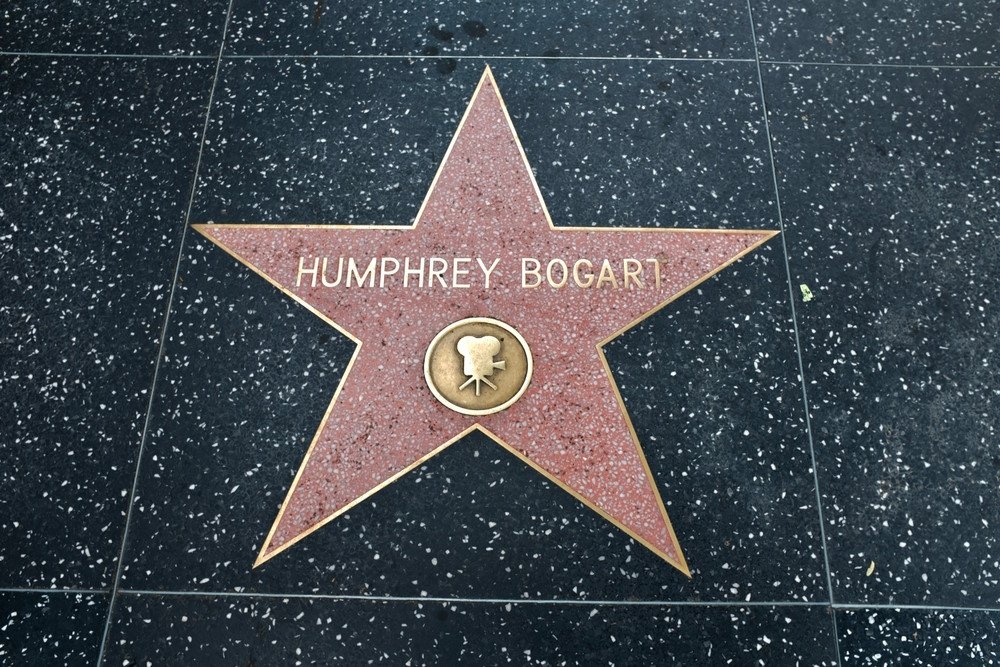
Humphrey Bogart is the undisputed, eternal high priest of classic Hollywood cinema. Voted by the American Film Institute as the greatest male screen legend in American film history, Bogart personified the world-weary, cynical, yet secretly romantic and morally incorruptible antihero that defined 20th-century screen masculinity.
With his trademark trench coat, fedora pulled low, a Chesterfield cigarette smoldering between his fingers, and that legendary lisping sneer, “Bogie” transformed screen acting from theatrical pomposity into gritty, naturalistic urban poetry.
1. An Aristocratic Christmas Birth in Manhattan
Despite playing rough-edged gangsters, escaped convicts, and hard-bitten private eyes throughout his film career, Humphrey DeForest Bogart was born into immense wealth and high-society privilege on Christmas Day, December 25, 1899, in New York City. Belmont DeForest Bogart, was a prominent Manhattan cardiopulmonary surgeon from an old Dutch colonial family, while his mother, Maud Humphrey, was a world-renowned commercial illustrator who trained in Paris under James McNeill Whistler.
Young Humphrey was raised in an opulent brownstone on the Upper West Side and attended the elite Trinity School and Phillips Academy in Andover, Massachusetts.
2. The Famous Scar and Distinctive Speech Lisp
Bogart’s distinctive physical appearance, characterized by a slight scar on his upper lip and a trademark gravelly, lisping speech delivery, became his most famous trademark, but its origin was shrouded in studio myth. Warner Bros. publicists frequently claimed that Bogart had been wounded by shrapnel while serving aboard the USS Leviathan during World War I, or that he was struck by a handcuffed prisoner trying to escape naval escort.
In reality, as close friends and his fourth wife Lauren Bacall confirmed, the scar resulted from a childhood accident: Bogart was struck in the lip by a splinter of wood or an errant toy, requiring stitches that permanently stiffened his upper lip and altered the movement of his mouth.
3. A Grueling Decade of Broadway Rejection and “Tennis Anyone?”
Bogart did not find instant stardom. After serving in the U.S.
Navy during World War I, he drifted into theater management and small acting roles on Broadway throughout the 1920s.
4. The Breakthrough That Rescued His Career: Duke Mantee
Bogart’s definitive breakthrough arrived with Robert E. Sherwood’s 1935 Broadway play The Petrified Forest, in which he was cast as Duke Mantee, an escaped, nihilistic mass murderer holding travelers hostage in an isolated Arizona diner.
Bogart based Mantee’s slouch, unblinking stare, and gravelly voice on real-life outlaw John Dillinger, earning ecstatic critical raves.
5. Winning His Solitary Oscar for The African Queen
Although universally associated with his iconic, Oscar-nominated performance as Rick Blaine in 1942’s Casablanca, Bogart won his only Academy Award for Best Actor for John Huston’s 1951 adventure masterpiece The African Queen. Filming in the grueling, disease-infested jungles of Uganda and the Belgian Congo, nearly the entire cast and crew contracted severe dysentery and malaria from contaminated drinking water.
Bogart and director John Huston famously remained completely healthy, attributing their immunity to drinking exclusively scotch whiskey instead of water: “All I ate was baked beans, canned asparagus, and scotch whiskey, and every time a mosquito bit me, he fell over dead.”
6. Defining Film Noir: The Maltese Falcon and The Big Sleep
Bogart was the foundational architect of American film noir. In 1941, director John Huston cast Bogart as Dashiell Hammett’s private detective Sam Spade in The Maltese Falcon, launching the golden era of noir cinema.
Bogart replaced the traditional, polished Hollywood hero with a hard-boiled, morally ambiguous cynic who operated in shadow, sneered at corrupt authority, and famously declared the titular falcon to be “the stuff that dreams are made of.”
7. The Immortal Romance with Lauren Bacall: “Bogie and Baby”
The greatest real-life romance in Hollywood history began on the set of Howard Hawks’ 1944 wartime adventure To Have and Have Not, when a 44-year-old Bogart met a 19-year-old former fashion model making her screen debut: Lauren Bacall. Their mutual attraction was instant and combustible: in the immortal hotel room scene where Bacall whispers, “You know how to whistle, don’t you, Steve?
You just put your lips together and blow,” their real-life romantic sparks permanently burned through celluloid. After divorcing his troubled, alcoholic third wife Mayo Methot, Bogart and Bacall married on an Ohio farm in May 1945.
8. Founding the Original “Rat Pack” in Holmby Hills
While modern audiences associate the “Rat Pack” with Frank Sinatra, Dean Martin, and Sammy Davis Jr. in 1960s Las Vegas, the legendary group was originally founded by Humphrey Bogart in the early 1950s at his Holmby Hills home. Born out of late-night drinking sessions, philosophical debates, and poker games with friends like Sinatra, Judy Garland, David Niven, and Spencer Tracy, the group was officially named by Lauren Bacall, who surveyed the disheveled aftermath of a four-day drinking session and remarked: “You look like a goddamn rat pack.”
Bogart served as the group’s “Director of Public Relations,” establishing tongue-in-cheek bylaws dedicated to “the relief of boredom and the continuation of independence.”
9. Defying the House Un-American Activities Committee (HUAC)
In 1947, during the height of the anti-communist Red Scare, the House Un-American Activities Committee (HUAC) began persecuting Hollywood writers, actors, and directors. Bogart, a fierce constitutionalist and lifelong supporter of civil liberties, co-founded the “Committee for the First Amendment” alongside Lauren Bacall, John Huston, Gene Kelly, and Danny Kaye.
In October 1947, Bogart and Bacall flew to Washington, D.C., to publicly attend the hearings, march in protest, and broadcast national radio programs defending free speech and denouncing government censorship.
10. A Passionate Master Sailor and His Beloved Santana
Bogart’s greatest sanctuary from Hollywood glamour was the open ocean. A master sailor and navigator, Bogart purchased the Santana, a magnificent 55-foot Sparkman & Stephens sailing yacht, from actor Dick Powell in 1945.
Bogart spent nearly every weekend and hiatus aboard the Santana, sailing between Newport Beach and Catalina Island.
11. Master Chess Prodigy: The Game in Casablanca
Bogart was an extraordinarily accomplished chess player who played at near-master tournament level. During the Great Depression, when acting roles dried up, Bogart earned money by playing simultaneous exhibition chess matches for fifty cents a game in Broadway chess parlors, regularly defeating top-tier competitors.
When filming Casablanca in 1942, the famous scene showing Rick Blaine sitting alone in his café analyzing a chessboard was Bogart’s personal idea. The chess position shown in the film was an authentic, complex defense Bogart was studying at the time.
12. A Courageous Farewell and Immortal Legacy
In 1955, Bogart was diagnosed with esophageal cancer, the consequence of decades of unfiltered Chesterfield cigarettes and scotch. Despite undergoing a grueling nine-hour surgery to remove his esophagus and suffering immense physical pain, Bogart faced his illness with trademark stoicism, humor, and courage, hosting friends like Frank Sinatra, Spencer Tracy, and Katharine Hepburn at his bedside.
His final film, Mark Robson’s boxing noir The Harder They Fall (1956), features Bogart in peak dramatic form as an honest journalist exposing mob corruption in boxing. Bogart passed away peacefully on January 14, 1957, at the age of 57.
Which choice on this list is your personal favorite? Share your thoughts and rankings in the comments below.