
Much of what you think you know about the Middle Ages is probably wrong. That dark, dirty time when people thought the earth was flat and knights were hoisted onto their horses with a tackle? Mostly Hollywood nonsense. The real Middle Ages were a lot more interesting, and often less barbaric, than films would have us believe. Here are ten persistent myths that you still believe thanks to Braveheart, Game of Thrones and countless other productions.
Which one of these deserves the top spot? Cast your votes below and let us know your personal ranking in the comments!
Cast your vote - the ranking shifts live based on the votes.
Vikings wore horned helmets
Imagine a Viking and you probably see a muscular warrior with two imposing horns on his helmet. That image is completely fabricated. The myth originated in the 19th century, when costume designer Carl Emil Doepler created horned helmets for a Wagner opera in the 1870s. Archaeological evidence is crystal clear: only one complete Viking helmet has survived, the Gjermundbu helmet from Norway, and it has no horns. Viking helmets were practical, often with a nose guard, made for real combat. Horns would only get in the way and give an enemy something to grab onto. The only horned helmets we know of from Nordic culture date from a thousand years before the Viking Age and were probably used for ritual purposes.
Medieval people thought the earth was flat
The myth that Columbus went against prevailing belief by believing the Earth was round is a 19th century fabrication. Washington Irving wrote a semi-fictional biography of Columbus in 1828 that popularized this idea. In reality, virtually every medieval scholar knew that the Earth was a sphere. The Persian scientist Al-Biruni calculated the radius of the Earth around the year 1,000 with a margin of error of only 31 kilometers. In the 13th century the textbook “De Sphaera Mundi” (On the Sphere of the World) was published and was widely used in European universities. The question was never whether the Earth was round, but how big the ocean was between Europe and Asia.
Log in to post a comment.
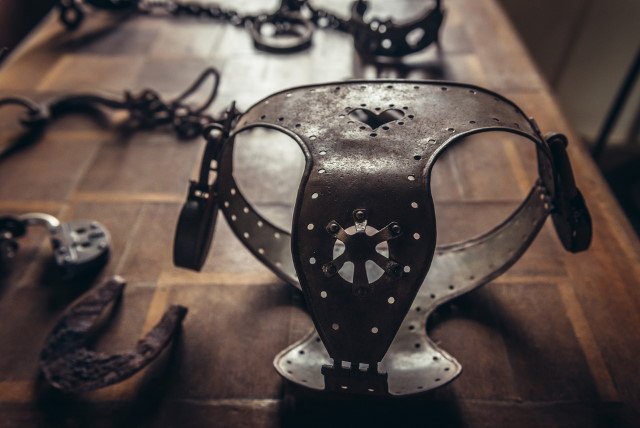
Chastity belts were actually used
The story goes that crusaders locked their women in metal belts before leaving for the Holy Land. Horribly romantic, but completely fictional. The first mention of a chastity belt comes from 1405, in a treatise by engineer Conrad Kyeser, and appears among sketches of fart jokes and an invisibility machine. It was a joke. In practical terms, a metal belt would lead to infections, skin irritation and worse within days, especially in an age without stainless steel. The British Museum states that virtually all “medieval” chastity belts in museums are 18th- and 19th-century forgeries, created as “curiosities for voyeurs or jokes for the tasteless.”
Log in to post a comment.
The Iron Maiden was a method of torture
That terrifying metal box with spikes on the inside? Never used in the Middle Ages. The Iron Maiden is a 19th century invention, probably assembled by collector Matthew Peacock from loose parts for museum exhibitions. The famous “Iron Maiden of Nuremberg” was only built around 1800 and was destroyed in an Allied bombardment in 1944. The Victorians were fascinated by the idea that the Middle Ages were barbaric, which enhanced their own “progress.” Torture did exist in the Middle Ages, but it was regulated by legislation and reserved for serious crimes such as high treason. Most punishments consisted of fines, public humiliation or quick executions.
Log in to post a comment.
People lived an average of 30 years
This misunderstanding stems from a misinterpretation of statistics. The average life expectancy was indeed around 30, but that figure was drastically reduced by high infant mortality. If you survived childhood, there was a good chance you lived to be 60 or 70. Many medieval figures lived to be very old: Eleanor of Aquitaine died at the age of 82, Pope Celestine III at 92. The 30-year myth suggests that people were already old at the age of thirty, but that is absurd. Medieval sources describe 30-year-olds as young and vital, not as old people.
Log in to post a comment.
Knights had to be hoisted onto their horses using a tackle
Laurence Olivier's film Henry V (1944) showed knights being lifted onto their horses by a crane-like device, much to the chagrin of the historical consultant on set. This image stuck, but is completely nonsense. Medieval armor was surprisingly mobile. A full suit of armor weighed 20-25 kilos, evenly distributed over the body, comparable to what modern soldiers wear in equipment. Knights could run, roll and take off independently. YouTube is full of videos of historians demonstrating this. The myth seems to stem from 19th century satire that was taken literally.
Log in to post a comment.
People never washed and smelled terrible
French historian Jules Michelet called the Middle Ages in the 19th century “a thousand years without a bath.” This is grotesque exaggeration. Even small villages had public bathhouses, and personal hygiene was actively encouraged. Medical textbooks of the time contained entire chapters on the importance of bathing. Stinking was associated with poor morale and illness. People washed their faces and hands daily, brushed their teeth with herbs and powders, and bathed regularly in rivers or bathhouses. Hygiene standards were different than today, but the image of muddy, smelly medieval people is a caricature.
Log in to post a comment.
Spices were used to mask spoiled meat
A popular story, but this is also nonsense. Spices such as pepper, cinnamon and nutmeg were extremely expensive, often more expensive by weight than meat itself. Those who could afford spices could also afford fresh meat. Moreover, medieval people were not backward: they knew when food had gone bad and had developed numerous preservation methods, including salting, smoking and pickling. Spices were used to show off wealth and make dishes tastier, not to disguise rot.
Log in to post a comment.
The “jus primae noctis” gave gentlemen the right to the bride
Braveheart made this central to the plot: the English king would have had the right to sleep with any Scottish bride on the first wedding night. There is no historical evidence that this right ever existed in Europe. Historian Alain Boureau wrote an entire book about it: “The Lord's First Night: The Myth of the Droit de Cuissage.” The myth originated in the late Middle Ages as a satire on the nobility and was later used by Enlightenment thinkers to emphasize the “barbarism” of the feudal system. It was propaganda, not reality.
Log in to post a comment.
Swords made a “shing” sound from their scabbards
That dramatic metallic sound when a hero draws his sword? Pure Hollywood foley. Medieval scabbards were made of wood covered with leather, not metal. Pulling a sword from such a sheath made almost no sound, at most a soft scrape. The familiar sound comes from modern metal sheaths or is artificially added for dramatic effect. The same goes for archers who say “fire!” shout: that command has only existed since the invention of firearms. In the Middle Ages, commanders shouted “loose!” (let go). Why do these myths persist? Most of these misconceptions arose in the 19th century, when Victorian thinkers liked to contrast themselves with a “dark” past. Renaissance humanists had already created a negative image of the “intermediate” period between classical antiquity and their own time, and that image was further magnified in Romanticism and the Industrial Age. Hollywood gratefully adopted these clichés because they are visually appealing. Horned Vikings look more imposing. Shiny armor is more photogenic than practical, matte versions. And a world of filthy, ignorant peasants makes our own time all the more comfortable. The real Middle Ages was a period of a thousand years, from the 5th to the 15th century, with enormous variation in cultures, developments and living conditions. It was not a monolithic “dark age,” but a complex era in which universities were founded, Gothic cathedrals rose, and scientific knowledge flowed from the Islamic world to Europe. Perhaps less cinematographic, but a lot more interesting than the myth.
Log in to post a comment.
Missing an item in this list?
Log in or create a free account to add an item yourself.
Log in / create account
Log in to post a comment.