
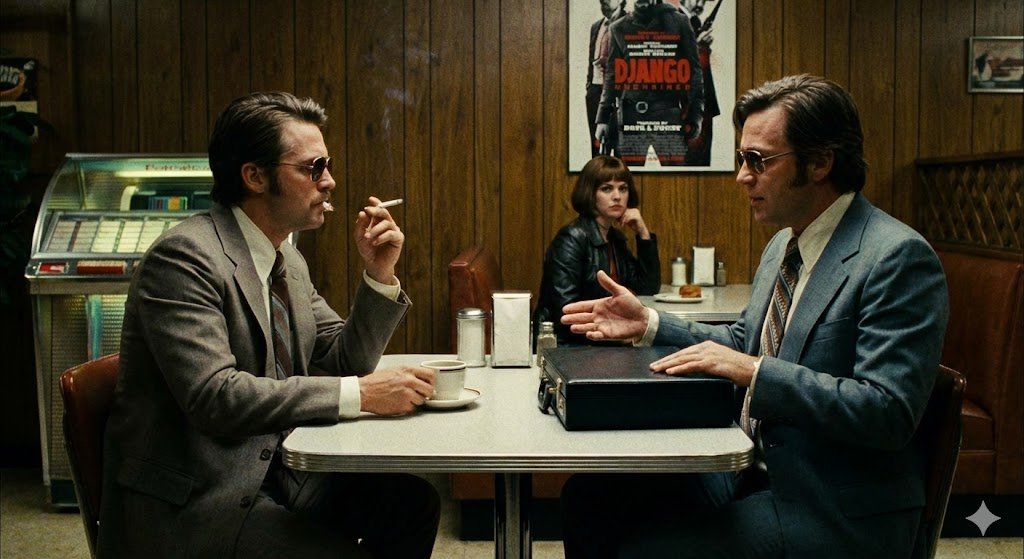
Quentin Tarantino is the ultimate movie nerd. He never went to film school; he 'went to the movies.' His masterpiece Pulp Fiction is essentially one giant love letter to cinema. He borrowed, stole, and sampled scenes from obscure B-movies and major classics to create something entirely new. If you want to see where Tarantino got his inspiration, you need to watch these 10 films. Vote for your favorite!
Cast your vote - the ranking shifts live based on the votes.
Kiss Me Deadly (1955)
Pulp Fiction's biggest mystery: what's in that briefcase? Is it gold? Marsellus Wallace's soul? All we know is it gives off a beautiful golden glow and everyone wants it. This plot device, known as a MacGuffin, comes straight from this film noir classic. Here too, everything revolves around a mysterious box that emits an eerie light when opened. Tarantino took this concept and made it iconic.
Bande a part (1964)
Tarantino is so obsessed with this French film by Jean-Luc Godard that he named his production company "A Band Apart" after it. The influence is felt everywhere, but especially in one specific scene. The famous dance sequence between Uma Thurman and John Travolta at Jack Rabbit Slim's is directly inspired by the dance in this film. Three misfits spontaneously start dancing in a Paris cafe. It's cool, a little strange, and pure movie magic.
Should honestly be #1. (14)
The Killing (1956)
Stanley Kubrick was already doing it back in the 1950s: telling a crime story where the timeline is completely scrambled. Just like in Pulp Fiction, we jump back and forth in time to see different perspectives of the same event. Tarantino has often said this was one of his biggest inspirations for the structure of his film. Without The Killing, we might never have gotten that brilliant prologue and epilogue in the diner.
Deserved every award for real.
The Bodyguard (1976)
"The path of the righteous man..." Everyone knows the Bible verse (Ezekiel 25:17) that Jules Winnfield (Samuel L. Jackson) recites before shooting someone "with great vengeance." But if you grab your Bible, you'll find the actual text reads quite differently. Jules' version comes almost word-for-word from the opening of this Japanese action film starring Sonny Chiba (also known as "Karate Kiba"). Tarantino simply thought it sounded "cool" and borrowed it for his own hitman.
Solid pick for #1 for real.
Psycho (1960)
Remember the scene where Butch (Bruce Willis) stops his car at a red light and suddenly sees mob boss Marsellus Wallace crossing the street? The look in their eyes, the tension, the slow turn of the head... This is a direct copy of the scene in Alfred Hitchcock's Psycho, where Marion Crane spots her boss crossing the street while she's on the run with stolen money. Tarantino uses the exact same framing to evoke that same sense of sudden paranoia.
Log in to post a comment.
American Boy: A Profile of Steven Prince (1978)
One of the most stressful scenes in film history: Mia Wallace overdoses, and Vincent Vega has to slam an adrenaline needle straight into her heart. This specific story comes from a Martin Scorsese documentary. In it, Steven Prince (a friend of Scorsese's) tells an anecdote about how he once had to save someone from an overdose with an injection to the heart. Tarantino listened, wrote it down, and turned it into film history.
Log in to post a comment.
Rio Bravo (1959)
Tarantino often calls this his favorite film. Why? Because it's a "hangout movie." You don't watch it for the plot, but because you enjoy spending time with the characters. Pulp Fiction does exactly the same thing. The conversations about foot massages, French hamburgers, and TV pilots have nothing to do with the plot, but they make us like the characters and want to "hang out" with them, even if they're killers.
Log in to post a comment.
Deliverance (1972)
When Butch and Marsellus end up in the pawnshop basement, the film suddenly turns into a nightmare. They come face to face with Zed, Maynard, and "The Gimp." This entire sequence is a tribute to the "hillbilly horror" of Deliverance. The idea of a tough city guy (or gangster) ending up in a world where his rules don't apply and he's confronted with primitive, sexual cruelty comes straight from this classic.
Log in to post a comment.
Black Sabbath (1963)
Pulp Fiction is what's known as an anthology film: made up of multiple separate stories woven together. This format was popular in 1960s Italian horror films. Mario Bava's film Black Sabbath consists of three short stories. Tarantino has specifically stated that this structure inspired him to tell crime stories in the same way, with characters from one story suddenly popping up in another.
Log in to post a comment.
His Girl Friday (1940)
Why do the characters in Pulp Fiction talk so fast and sharp-witted? That comes from the screwball comedies of the 1930s and '40s. In His Girl Friday, the characters talk at lightning speed, talk over each other, and are always quick with a comeback. Tarantino wanted his gangsters to sound not like dumb criminals, but like the sharp journalists in this film. The rhythm of the dialogue in Pulp Fiction is purely musical, just like in this old classic.
Log in to post a comment.
Missing an item in this list?
Log in or create a free account to add an item yourself.
Log in / create account
Pulp Fiction's biggest mystery: what's in that briefcase.
Log in to post a comment.