
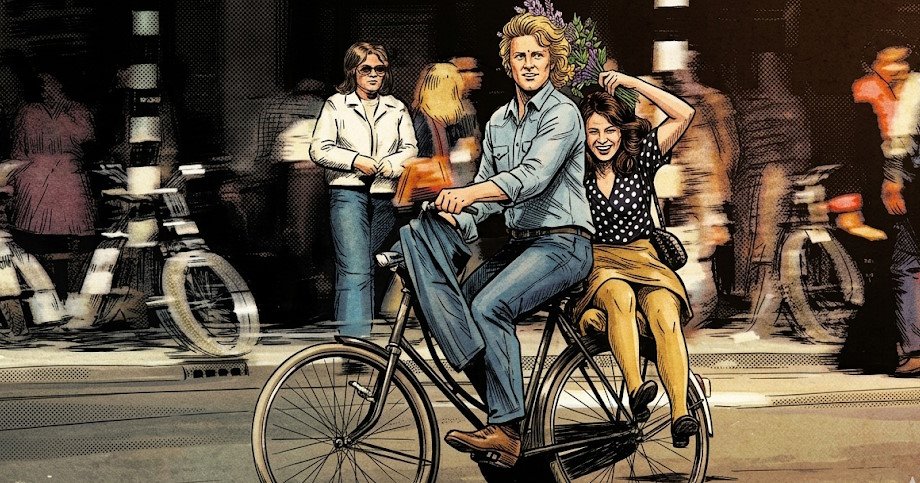
Dutch cinema is often blunt and raw -- no exaggerated Hollywood glitter here. Homegrown filmmaking moves between provocation and deep melancholy. Here's a collection of movies that ruthlessly expose the Dutch soul, and that we believe every film fan should see at least once. Vote for your favorite below!
Cast your vote - the ranking shifts live based on the votes.
Turkish Delight (1973)
Paul Verhoeven directed the definitive Dutch film classic with Turkish Delight. Rutger Hauer plays the sculptor Erik, and Monique van de Ven makes her debut as his great love Olga. Their relationship is passionate and chaotic, but ends tragically. The film is raw and deeply emotional. Audiences were captivated by its frank portrayal of sexuality and emotion -- one in four Dutch citizens saw the film in theaters, a record that still stands. The production won the Golden Calf and earned an Oscar nomination. Fifty years later, the film still tops nearly every list of the greatest Dutch films ever made.
Borgman (2013)
Alex van Warmerdam made the strangest Dutch film in decades. A mysterious vagrant infiltrates a wealthy family and begins psychologically manipulating them. Surreal and violent events unfold without clear explanation, and the ending remains deliberately ambiguous, leaving the viewer with far more questions than answers. The film competed at Cannes for the prestigious Palme d'Or. It's not accessible, easy viewing, and it offers no tidy answers.
Soldier of Orange (1977)
Verhoeven brought the story of Erik Hazelhoff Roelfzema to life. A group of Leiden students see their carefree lives collapse when the Germans invade. Erik flees to England to fight for the cause, while his friends each choose their own path. Their friendship ultimately breaks under the immense pressure of war. The director wanted to deliver Hollywood quality on a Dutch budget, filming across the Netherlands, England, and Spain to convey the scale of the conflict. The film turned Rutger Hauer into a world star.
Black Book (2006)
After 26 years in Hollywood, Paul Verhoeven returned to his home country. With a budget of 16 million euros, he made the most expensive Dutch film ever. Carice van Houten plays Rachel, a Jewish singer who goes undercover with the Gestapo. The film avoids the usual black-and-white morality of war stories -- betrayal comes from every direction. Van Houten delivered a performance that opened international doors for her. The film grossed $26 million worldwide and proved Verhoeven hadn't lost his edge.
Love Is All (2007)
Joram Lürsen directed this Dutch take on Love Actually. Multiple storylines intersect in Amsterdam during the month of December. A prime minister falls for his assistant, and a father tries to repair his relationship with his daughter. On Christmas Eve, everyone ultimately finds some form of connection. While some critics found it sentimental, audiences loved it, and the film has since become a fixture of holiday TV programming.
Spetters (1980)
Paul Verhoeven made one of the most controversial Dutch films ever with this story about three young motocross riders. The uproar following its release was massive due to its explicit scenes. Verhoeven, however, refused to make concessions and defended his artistic freedom. The film drew 1.1 million viewers and remains an unflinching portrait of youthful frustration in 1980s Netherlands.
Flodder (1986)
Dick Maas scored again, this time with a crude comedy about an antisocial trailer-park family. They are placed as a social experiment in the upscale suburb of Zonnedael. Ma brews gin in the kitchen while Johnnie schemes criminal plans. The neighbors are horrified and try to get rid of them, but the Flodders aren't going anywhere easily. The film drew 1.8 million moviegoers, spawned two sequels and a long-running TV series, and turned Tatjana Simic into a national sex symbol. As of 2026, a new Flodder film is even in the works.
New Kids Turbo (2010)
Steffen Haars and Flip van der Kuil turned their YouTube series into a massive box-office hit. Five unemployed "gabbers" from the fictional town of Maaskantje lose their welfare benefits during the credit crisis. Their response is simple: they declare war on the town council and eventually on the entire country. Chaos, explosions, and absurdity pile up at breakneck speed. The humor is crude and politically incorrect, but the film flawlessly captured the frustration of that era.
The Lift (1983)
Dick Maas directed, wrote, and composed the score for his debut feature. In an Amsterdam office building, an elevator starts killing people. Elevator technician Felix Adelaar (Huub Stapel) investigates the mysterious accidents and discovers a malfunctioning microchip that somehow appears to be evolving. Maas was only 26 and the budget was a mere 1.5 million guilders, but the film still holds up remarkably well today. The tension is constant throughout -- Dutch horror that effortlessly competes on the international stage.
Simon (2004)
Eddy Terstall directed this intimate film about friendship and farewell. Cees Geel plays Simon, an Amsterdam hash dealer who discovers he has terminal cancer. Rather than sinking into self-pity, he decides to spend his final months matchmaking for others -- helping his childhood friend find her dream man and resolving his neighbor's relationship crisis. The film won a Golden Calf for Best Film and Best Actor.
Missing an item in this list?
Log in or create a free account to add an item yourself.
Log in / create account